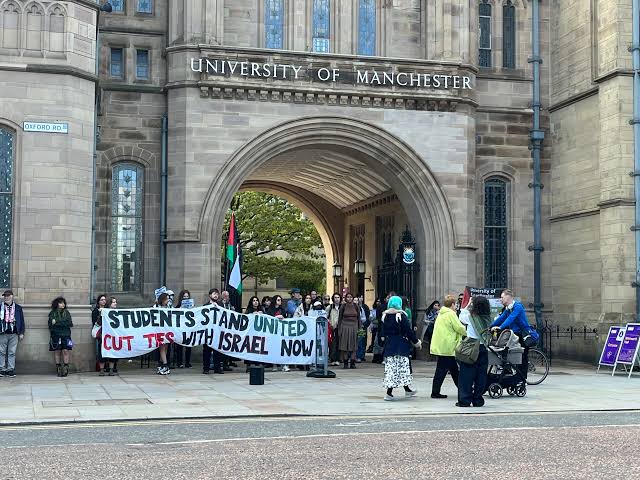
The University of Manchester (UoM) has planned to relaunch its partnership with Tel Aviv University (TAU), less than one year after a motion to cut ties with the Israeli university was backed by 94% of votes cast at Union Assembly. The turnout was 4,831.
Collaboration between the two universities is planned to resume as part of UoM Global Fund, a new twice-yearly scheme that brings five universities under the same funding model to support research.
The initiative was announced on 28 July via a StaffNet post, UoM's internal staff intranet. The post did not mention the specific 'partner institutions' involved in the fund.
A second guidelines document, hyperlinked in the original announcement, did not mention the participating universities either.
The list of universities can be publicly accessed through a link in the UoM Global Fund guidelines document, which leads to an application landing page. The landing page explicitly names Tel Aviv University as one of the five institutions selected for the scheme, meaning The University of Manchester plans to resume the partnership after three years.
For the Global Fund, UoM contributes £5000 per project; the partner institution a similar amount. Applications for the funding open on September 1st. The other universities involved are Germany's Heidelberg University, India's Manipal Academy of Higher Education, China's Peking University, and The United States' University of Texas at Austin.
In the StaffNet post, Professor Angie Wilson, Associate Vice-President for International at UoM, said that the fund was aimed at 'Investing in your efforts to build partnerships with our peers across the world will help us deliver our Manchester 2035 strategy, including our ambition to be the partner of choice for those who share our commitment to excellence and turning knowledge into impact for the public good.'

Students occupy the Simon Building on University of Manchester campus in March 2025. Credit: Eve Jordan @ Fuse TV
The original UoM-TAU partnership funded a total of eighteen joint projects from 2021-2023, 'none of which [were] related to defence research or have any military links'.
Up to 8 joint projects every year would receive up to £5,000 from both universities. A paper provided to supplement the Student Union motion notes that 'each partner pays its own costs' and there is 'no transfer of funds between institutions'.
As of October 15, 2025, £52,622 had been used on research projects, which have ranged from a 'Biorobotics Research Network' to studies of 'Linguistic imperialism and the demotion of Arabic in Israel'.
The partnership was postponed in 2023 'because of the Israel-Hamas war', a freedom of information request made to UoM in late 2024 said.
UoM said they hoped to reopen applications in 2025, though a date had not yet been confirmed.
The TUA partnership has drawn criticism from student groups and academics alike since its inception. In 2021, more than 200 academics signed an open letter opposing the venture.
Addressed to Dame Nancy Rothwell and the university's senate, the open letter argued that TAU was 'deeply implicated in Israel's premeditated bombing of civilians and civilian infrastructure in Gaza,' and that the partnership contravened UoM's 'ethical commitment to oppos[ing] racist violence and oppression'.
On campus, student activists led protests and occupations of buildings, such as Samuel Alexander, Roscoe, and Simon. In 2024, students staged a barricade of the Whitworth building on Oxford Road.
In a twelve page document from March 2025, that was cited in Union Assembly, the Youth Front For Palestine Student Society, who helped organise the protests and the Student Union motion, argued that Tel Aviv University was 'an arm of the Israeli state's occupation and ethnic cleansing of Palestine'.
A spokesperson from the University of Manchester said, 'The University's research collaborations, including those involving Tel Aviv University (TAU), are academic in nature and exist to advance knowledge. They are carried out within UK law and the University's ethical and research governance frameworks. Decisions on whether to participate in these collaborations are made by individual academics on a voluntary basis and are underpinned by the principle of academic freedom.
The Staffnet announcement was an internal advance notice of the Global Fund and provided a high-level overview of the scheme for colleagues ahead of its formal launch on 1 September. Information on participating institutions, including TAU, was available through the accompanying guidance and application materials. TAU is one of six universities in the first call, with a second call, including different universities, to follow in Spring 2027. These are researcher driven initiatives and future rounds will be determined by the interest in and outcomes achieved through these collaborations.
The fund forms part of our wider approach to international partnerships introduced through the M2035 International Delivery Plan, which will launch in September. This includes an announcement of our new university-wide global initiatives, which operate separately from the more flexible Global Fund collaborations.
Decisions about international research partnerships are taken collectively through the governance of our University committees. The University's governing bodies, including Senate, have previously debated and voted against ending the partnership with TAU. That decision reflects careful consideration of legal, ethical and academic principles, as well as the importance of international academic collaboration. These principles are summarised in our Statement of Social Responsibility in our Research
We understand and acknowledge the diverse views and feelings expressed by many of our students, and remain committed to supporting lawful, respectful ongoing conversation and debate about these issues'.
A spokesperson from Action 4 Palestine said, 'This secretive re-launch of the partnership with TAU, Israel’s academic army base, after almost three years of genocide in Gaza represents the university’s complete disdain for both Palestinian life and their own students. Last October, students made it overwhelmingly clear that they oppose this partnership and do not accept bogus justifications for working with TAU.
Student anti-Zionist activists have been campaigning for years for this partnership to be dropped, with widespread student and staff support. To covertly restart this partnership whilst many members of staff and students are away from campus over summer is a cowardly admission of guilt and rejection of public scrutiny.
Since the SU vote, TAU has only deepened its involvement in genocide and occupation. In February, TAU sold its share in its flagship startup XTend, an Israeli quadcopter company which claimed to have “redirected energies to supporting the IDF 100%.”, profiting $25 million from this criminal venture. Student soldiers at TAU have continued to study how to make the genocide more efficient and volunteered their time to support frontline IOF soldiers who are still massacring Palestinians daily. TAU has also announced archaeology work in illegal settlements, further violating the rights of Palestinians and desecrating their land.
Shame on UoM for including TAU in the Global Fund. The students have spoken, drop Israel's academic army base now.
We call on academics to boycott this partnership and refuse to make themselves complicit in TAU’s crimes. We will continue to escalate our campaign until the university ends this blood-soaked partnership'.
Comments
Powered by DisqusComments are provided by Disqus.