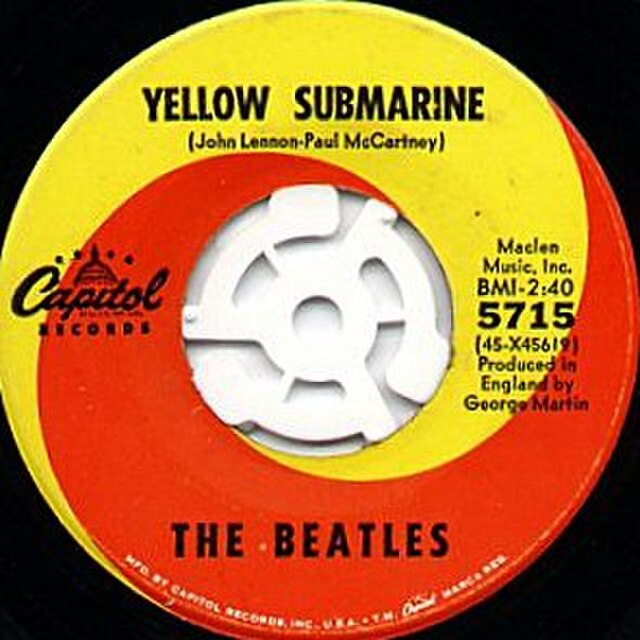
If any record by The Beatles deserves to be called overlooked, it's their 1969 soundtrack for Yellow Submarine. Most Beatles fans don't even know it exists, and there’s a reason why - half the album is made up of George Martin’s orchestral instrumentals, and its two biggest tracks, ‘Yellow Submarine’ and ‘All You Need Is Love,’ had already appeared on Revolver and Magical Mystery Tour. The four original songs are the real draw to the album, and one of them - 'It's All Too Much' - is a masterpiece that sadly many fans will never hear.
Before we get into the track, it's important to contextualise where George Harrison, the driving force behind it, was at in May 1967 when the track was recorded. The band had just finished recording Sgt. Pepper's and were working on songs including 'Baby You're a Rich Man' and 'Magical Mystery Tour' for their next album release. They were in a peak of psychedelic creativity, and Harrison took that creativity even further. Having first taken LSD two years earlier, Harrison’s music had grown more introspective and spiritually curious. ‘Within You Without You’ from Sgt. Pepper’s is a prime example, with a self-assured, meditative tone and cryptic lyrics. His immersion in Indian philosophy and his tutelage under sitarist Ravi Shankar had further shifted his musical lens away from simple Western structures and towards transcendental meaning, encouraging him to add Indian instruments to his recordings.
But even by the time 'It’s All Too Much' was completed, Harrison’s relationship with psychedelics was beginning to shift. Although LSD had opened him to broader ideas about consciousness, he later grew disillusioned with its fleeting nature after a disastrous visit to the drug-addled Haight-Ashbury neighbourhood of San Francisco. He increasingly saw meditation - especially through his study of Transcendental Meditation with Maharishi Mahesh Yogi - as a more sustainable and meaningful path to "spiritual completeness".
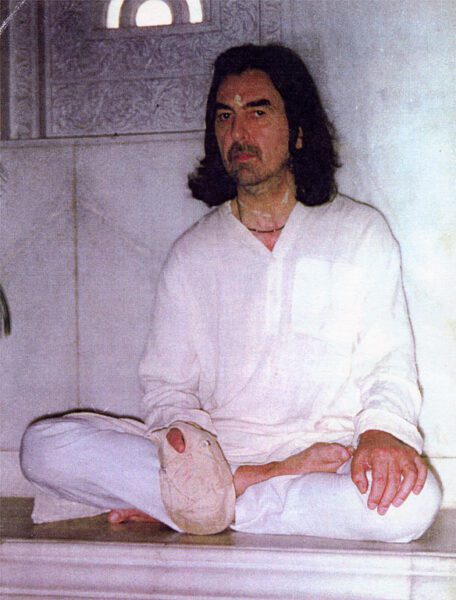
George Harrison in India. Credit: Gaura @ Wikimedia Commons
'It’s All Too Much' sits right at that turning point: the tail-end of his psychedelic phase, just before his deeper spiritual search took over. Gone are the mantra-like musings, gone are the sitars and tabla-driven textures. In their place is a song that captures the pure ecstasy in psychedelia, a maximalist celebration of LSD. The dirty feedback jams of bands such as The Velvet Underground are shone through a prism of classic early Beatles euphoria, creating a remarkably forward-thinking track with its joyous attitude towards drug-taking, and standing as a rave tune thirty years too early.
The song was recorded over several sessions at De Lane Lea Studios, which was a rarity for the band who typically and famously worked at Abbey Road. The sessions were jam-based, giving the track its raw, expansive feel. The original version stretched over eight minutes, filled with extended instrumental sections and heavier sonic experimentation, in addition to lyrics removed from the final cut. Running over six minutes, the final cut is nonetheless one of the longest Beatles studio recordings officially released.
Lyrics displaying a tone of surrender and awe are mixed with classic Beatles humour that shines through in lines such as "all the world is birthday cake, so take a piece but not too much” which both embraces joy and subtly warns against excess. Meanwhile, the lyric “floating down the stream of time from life to life with me” could’ve been lifted straight from 'Lucy in the Sky with Diamonds', but it also hints at Harrison’s growing interest in Eastern philosophy, particularly the Hindu concept of samsara, the cycle of rebirth.
The unedited take included additional lyrics, such as “nice to have the time to take this opportunity / Time for me to look at you and you to look at me", an intimate and self-reflective contrast to the cosmic out-of-body experience suggested by other lines. The improvisational spirit of these sessions shows Harrison at his most relaxed and playful, unburdened by the competitive Lennon-McCartney dynamic. The track builds gradually, layers stacking into a swirling wall of sound that peaks in a wild finale. Blaring trumpets erupt alongside a raucous chant of “too much!”, simulating a full-blown psychedelic overload.
The trumpets, added by George Martin, lend the song a sense of triumph, their regal tone cutting through the fuzzed-out chaos like a ceremonial fanfare. They also inject a distinctly English flavour, a kind of whimsical pomp that roots the track in tradition even as it floats off into cosmic abstraction. That contrast between psychedelic transcendence and domestic Britishness is summed up perfectly by the lyric “show me that I’m everywhere, and get me home for tea”. Harrison later claimed the trumpets "messed up" the song, yet five and a half decades later it is clear that they complete it. The track's magic lies in how it fuses spiritual psychedelia with euphoric Beatles pop sensibility, a balance none of their other songs quite fully manage.
'It’s All Too Much' is a genre-blender years ahead of its time. Acid rock, psychedelia, garage fuzz, noise pop, and even proto-shoegaze textures combine together to create an avant-garde vision of the future. The droning guitars, saturated with feedback and delay, were surely a huge influence on bands like my bloody valentine and Spacemen 3. At the same time, its groove-oriented repetition and baggy rhythm, blending rock and dance, predict the Madchester sound of the late 80s and early 90s - particularly that of acts such as The Stone Roses and Happy Mondays. The track only got an actual single release in 1996 on a Capitol jukebox record, potentially contributing to its muted reception over the years. Had it appeared on a major studio album, it would likely be celebrated alongside ‘A Day in the Life’ or ‘Tomorrow Never Knows’ as one of their most daring creations. Unfortunately, it still remains a deep cut. For fans of The Beatles, or even just lovers of psychedelic music, this is a must-hear
Comments
Powered by DisqusComments are provided by Disqus.