The first thing I ever bought on Vinted was a pair of Dr. Martens. They were cracked from back to front, covered in muck, and took weeks to break in. But they were real, cheap, and lived in. Even better, they were mine.
Vinted is a Lithuanian resale platform with a goal of making second-hand clothes our first choice. The app is the brainchild of Lithuanian entrepreneur Milda Mitkute, who founded the service in 2008 as a website. Since then, Vinted has grown exponentially. It’s the first Lithuanian ‘unicorn’ – finance-speak for a company valued at over 1 billion – and now boasts over 120 million registered users globally, 18 million of those in the UK.
The charm of my docs wasn’t just their character: Vinted’s appeal was its community focus combined with its usability, which allowed second-hand clothes to be bought and sold with ease and friendliness. It felt like a world untouched by high-street inflation and money hungry resellers (official images of apparel were banned, which meant that clothes had to be photographed at home), creating a stark contrast to the way other second-hand online shops like Depop or eBay were perceived. Unlike Vinted, Depop requires faffy guidelines to upload, and a processing fee for sellers on each transaction.
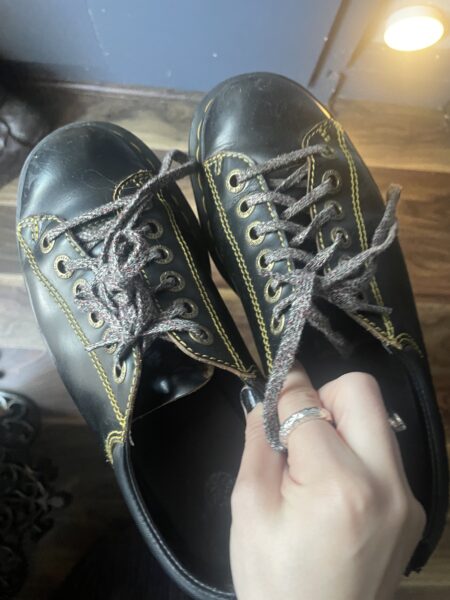
The author's first Vinted purchase, some Dr. Martens. Credit: Heidi Taylor
In 2023, Vinted reported a 61% surge in profits, with Depop acknowledging a loss in earnings that same year. But when Vinted was achieving accolades at the 2025 Media Campaign awards for its focus on second-hand, I couldn’t help but feel misled. The app's initial focus on authenticity felt like it was fading away.
For Summer, 19, the platform had slowly turned into an “overpriced Primark”. With ads for fast fashion brands popping up every few minutes, and sellers conveniently losing authenticity tags, Vinted became flooded with fast-fashion, mass produced items, at an extortionate, hiked-up price. When Summer scrolls through Vinted now, tired leggings and expensive trainers sit together, dejected in their 2D boxes.
"It’s like being sucked into a misleading rabbit hole of fast fashion,” Summer said. For her, like many young people, the app was vital for the way in which it allowed her to experiment with new styles at a low cost, an affordability lost with time. “I wouldn’t want to spend £30 on an item from a first-hand shop that I'd never wear again. [Vinted] gave me the chance to try new options without breaking the bank”.
Summer’s reluctance to use the service hints at a disconnect between Vinted and the younger generations its marketing schemes target. Since then, articles have criticised buyer protection fees, a poor refund system, and an optional fee to “boost” listings.
Part-time postman Eric, 71, is extremely interested in shopping culture and how it impacts our carbon footprint. He told me about the excessive waste caused by larger corporations, as well as the sheer volume of parcels that his post office receives daily. He criticised “the increasing quotas” and “[the] prioritisation of parcels [over letters]”.
To Eric, Vinted is now less a solution to finding vintage clothes but its own, often damaging cycle of online consumer culture. This, he says, has impacted the actual function of the Post Office. “I’ve been told to deliver all Amazon parcels before I touch electricity bills”.
Even if Vinted has become a second-hand marketplace without vintage clothes, Eric says that he is “happy that the power is being taken away [from larger companies]”. For him, Vinted deserves more acknowledgment for how it has (and continues to) reduce carbon footprint and the urge to online shop first-hand fast fashion. “It’s nothing but a positive”, he says. “Does it matter if it loses its vintage, if it retains some of our planet?”
Arguably, Vinted’s movement towards fast-fashion could be seen as natural, the price to pay for a cost-of-living crisis and an inscrutable job market. We can’t blame people for seeing an opportunity to make money and taking it. But the changes threaten to target reputation of the brand, alienating a section of Vinted’s target audience, and, in the long run, making it feel impossible to shop authentic vintage anywhere.
Still, we must also confront the fact that fast fashion is ever-growing. Vinted’s popularity can help curb the amount of money spent on first-hand clothing, thus reducing profits for large companies, that are abusing our world and those in it. So, maybe Vinted has lost its vintage, but in the long run, it's saved us a lot more than it's taken.
Comments
Powered by DisqusComments are provided by Disqus.