On 26 March the UK Home Office imposed a ban on study visas issued to nationals of Sudan, Cameroon, Myanmar and Afghanistan. As justification for the ban the Home Office claimed that study visa abuse is ‘widespread’ among nationals of the four affected countries. In a Home Office press release, Home Secretary, Shabana Mahmood, said:
“Britain will always provide refuge to people fleeing war and persecution, but our visa system must not be abused.
“That is why I am taking the unprecedented decision to refuse visas for those nationals seeking to exploit our generosity.
“I will restore order and control to our borders.”
Mahmood proposes the nationality of students from the four visa brake countries as a reason to believe that they are not genuine scholars and are instead exploiting the study visa system in order to claim asylum. The Home Office justified this claim using figures, previously investigated by The Mancunion, that have been described as ‘misleading’ by Russell Group. Government press releases have failed to directly quote the raw numbers of asylum claims made by students from the four affected countries in the last five years.
Russell Group have written to the Home Office arguing that the blanket ban will prevent “genuine, exceptionally talented students from coming to the UK”, and calling for “clearer, evidence-based communication” from the Home Office.
In contradiction to the Home Office’s claim of ‘widespread visa abuse’, Russell Group argues that “the vast majority of international study applications are genuine”. The Mancunion has conducted an investigation aiming to provide clarity on the statistics and document how the ban has affected genuine, talented students holding offers to study at The University of Manchester.
Prior to the March 2026 immigration system statistics release (published 21 May 2026), a breakdown by nationality of the number of people claiming asylum by route of entry to the UK was not publicly available. Hence the number of students from Sudan, Cameroon, Myanmar, and Afghanistan claiming asylum was not accessible in public data releases.
A Freedom of Information (FOI) request by The Mancunion revealed that the Home Office does hold this data, yet chose not to quote the raw figures to evidence the claim of ‘widespread visa abuse’ in their press release. In response to The Mancunion’s FOI request, the Home Office confirmed that a breakdown of asylum statistics by both nationality and route of entry to the UK would be made available for the first time in the May 2026 release of immigration system statistics.
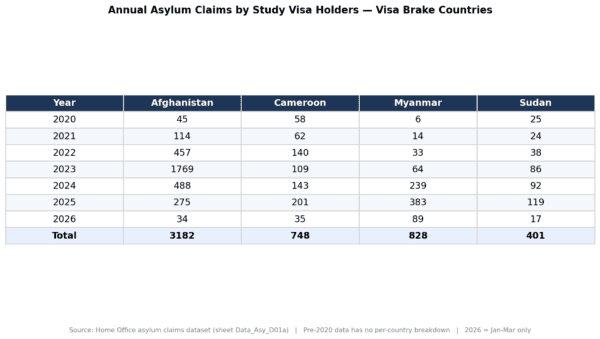
The Mancunion can reveal that between January 2020 and March 2026: 401 asylum claims were made by Sudanese nationals who had entered the UK on a study visa; 3182 by Afghan nationals; 748 by Cameroonian nationals; and 828 by nationals of Myanmar.
Credit: Claudio Mecklenburgh @ The Mancunion
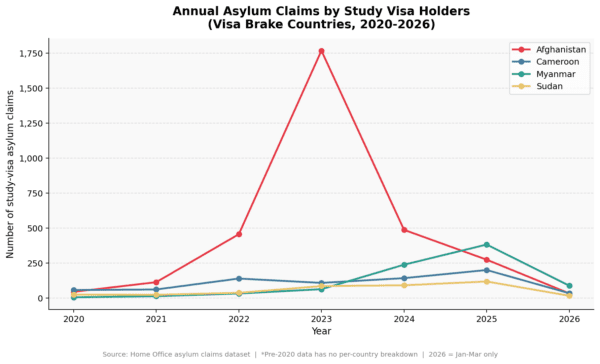
In the same time period 500,000 asylum claims were submitted to the Home Office, meaning students from the 4 visa-ban countries accounted for roughly 1%. However, this includes a spike in asylum claims by Afghan students around 2023, which coincides with the banning of women from higher education by the Taliban in 2022.
Credit: Claudio Mecklenburgh @ The Mancunion
Following 2022, the number of Afghan students claiming asylum returned to previous levels. Looking solely at 2024 and 2025 – both years in which the Home Office received over 100,000 asylum applications – asylum claims made by students from the four visa-ban countries made up only 0.1% of applications.
Additionally the statistics support the fact that Sudanese nationals are not abusing student visas en masse. Of the 20,510 Sudanese nationals who claimed asylum between January 2021 and March 2026, only 1.8% were students. This is a lower proportion than 66 other countries including the United States, China, Egypt, Syria, Morocco, and Algeria.
In response to the visa ban, The University of Manchester’s Sudanese Society joined the ‘Restore Sudanese Student Visas’ campaign, which argued that “the blanket ban punishes genuine scholars, Chevening candidates, and postgraduate researchers whose only connection to the asylum system is their nationality.”
To further understand the impact of the ban on these prospective students, The Mancunion spoke to Sudanese nationals who had secured offers to study at the University of Manchester before seeing those offers withdrawn following the policy change. Their accounts provide insight into the personal circumstances of students affected by the change.
For Ms Alameldin, studying in the UK was intended as a step towards contributing to Sudan’s future development. Having secured an offer for an MSc in Planning at the University of Manchester, she said her ambition was never to settle permanently in the UK but instead to gain skills and experience that she could eventually bring home. She told The Mancunion: “Sudan is in dire need of skilled Sudanese professionals from various disciplines to rebuild and advance the country.”
She had already planned to use the qualification to pursue a career in public service and academia, explaining that her long-term goal was to “work in the Ministry of Urban Planning in my country as a planner and an academic professor at my university.”
The policy change has left those plans in jeopardy. Recalling her reaction to the withdrawal of her offer, she said “I felt so disappointed, and my heart was broken, because I had planned and arranged for every single detail to go into the Master’s programme in the UK (...) Now I have no plan B.”
Beyond the personal disappointment, Alameldin stressed the wider impact on her family, explaining that studying in the UK would have given her the chance to develop professionally while supporting relatives affected by the conflict in Sudan. The degree represented an “opportunity of being prepared for the labour market and helping my family who are relying on me now after the conflict”
Mr Mohamed, another Sudanese national whose offer was withdrawn, similarly rejected the implication that students from Sudan are primarily seeking entry to the UK as a route to asylum. Having spent years planning for postgraduate study, he said the Home Office’s justification was not an accurate reflection of the realities facing international students.
“If you have that kind of money [to study in the UK], you wouldn’t be entering the UK through a student visa to gain asylum,” he said. “Asylum isn’t the objective.”
Mohamed later expressed that there is no motivation for Sudanese students to use the study visa route as a means to claim asylum:
"Those who have gained admission or scholarship from a Russell Group University have invested resources and time that asylum as a compensation cannot motivate, reward, or justify. Asylum, if chosen, is a last resort for those who need it most and couldn't do without it."
Instead, Mohamed described education as an investment in both personal development and the future of his community. “One wants to contribute to his family, to the area he comes from, to the region he comes from. He would like to see it prosper and grow.” Like Alameldin, he viewed postgraduate study in the UK as a means of gaining expertise before eventually returning home.
Mohamed also recounted feeling shocked by the announcement. “It was devastating. I was in disbelief at the beginning,” he stated, explaining that he had already invested a significant amount of time, money, and effort into preparing for study in the UK. He argued that “this decision has harmed a lot of people and I doubt it made any profit or gain.”
The desire to use education as a tool for rebuilding Sudan was also echoed by Ms Ahmed, another Sudanese applicant whose offer to study a BSc in Pharmacology, was withdrawn following the ban. Ahmed described her educational ambitions as inseparable from the conflict in Sudan, explaining that her family had lost “nearly everything” during the war.
Rather than seeing higher education as a means of leaving Sudan behind, she viewed it as preparation for contributing to the country’s future recovery. “I want to be able to gain the knowledge and skills to help rebuild my country,” she told The Mancunion. “Education is what is needed to rebuild [Sudan] and it acts as a foundation for rebuilding society and creating long-term peace and opportunities.”
Ahmed also challenged the implication that Sudanese students are primarily motivated by asylum. “Many of us are not just seeking asylum,” she said. “We’re seeking knowledge to gain and rebuild and strengthen our country.”
Having held her offer since November 2025, she said the ban left her questioning what would come next and dramatically reduced her options for higher education. Despite this, she remains committed to studying in the UK if the policy is reversed, stating that she “would definitely come.”
Another prospective postgraduate student, Mr Ammar, who received an offer for an MSc in Thermal Power and Fluid Engineering, also emphasised how he planned to use skills gained in research “to find ways to study how Sudan’s natural resources could be used to [produce] stable electricity.”
Ammar described the feeling of frustration he felt after hearing about the change to immigration law, saying:
“Since the war in Sudan I have heard many people saying that other countries will be more accepting of people from Sudan.” However, according to Ammar, this has not been the case.
“As well as the war being an emotional and economic stress, I have also had a weight on my shoulders from trying to prove that when I am coming to study I am not coming to stay.” Ammar’s frustration at having to prove himself as a legitimate student was also clear. Ammar described his education as a necessity; a sentiment he said is shared across communities in Sudan:
“The richest and the poorest person you know all have education as a priority.”
When asked what he thought of the Home Office’s response to the study visa ban, Ammar said:
“I don’t think that the UK [government] should talk about providing asylum and immigration to Sudanese people.
“If they were honest about it - that they don’t want Sudanese people here - … then maybe a lot of people wouldn’t build their plans on reaching the UK.”
Ammar is not alone in his concerns. Russell Group has called on the Home Office to provide for "clearer, evidence based communication", and "more transparent data sharing". The Home Office claimed that the number of asylum applications by students from the 4 visa-ban countries poses an "unsustainable threat to the UK's asylum system". However, the latest release of immigration system statistics shows that in the last two full calendar years only ~0.1% of asylum claims were by students from the 4 affected countries.
Additionally, since 2020 the percentage of Sudanese asylum claims made by people who entered the UK on a study visa was lower than 2%. The scale of these figures supports the Russell Group’s argument that the measures taken by the Home Office are “disproportionate and risk causing harm to prospective students.”
The testimonies of these students raise questions about the assumptions underpinning the Home Office’s policy. For many of those affected, the ban has disrupted carefully planned academic and professional futures.
Far from describing study in the UK as a route to permanent settlement or claiming asylum, the applicants interviewed by The Mancunion spoke proudly of education as a means of acquiring skills and contributing to their homeland.
The Home Office was contacted for comment; however, no response has been provided to date.
When approached for comment, The University of Manchester Sudanese Society's 2026 committee stated:
"The government has framed this as a response to immigration pressures, but tackling that pressure by closing the door on students is the wrong approach. The issue, if there genuinely is one, needs to be addressed at its root, not by punishing people who came here for one purpose: to learn, grow, and contribute.
"Sudanese students who arrive on study visas do exactly that. They excel across a huge range of disciplines in UK universities, and they bring real value to the institutions and communities they join. Even in cases where individuals go on to seek asylum, many of them remain engaged, contributing to society and the economy as they pursue work and build lives here.
"These are not people exploiting a system. They are people fleeing a country currently experiencing one of the worst humanitarian crises in the world, while still managing to give back to the country that gave them a chance.
"Punishing innocent students for a policy failure that has nothing to do with them is not a solution, it is a deflection. If the government wants to address immigration concerns seriously, it should look at the root causes rather than shutting out individuals who pose no threat and who have only ever sought to better themselves and the communities around them."
When approached for comment, the Students' Union executive officer team said:
"The officer team strongly believes that the visa brakes are yet another step in the wrong direction. This change highlights a series of hostile policies targeting migrants and negatively impacting international students- from the May 2025 immigration white paper to increased compliance regulations. These actions mean the UK is becoming an increasingly negative environment for migrants.
"We’re currently working with the Russel Group and members of the Global Student Advisory Board to lobby policy makers on ending the visa brakes."
When contacted on this issue, a University of Manchester spokesperson said:
“We recognise the uncertainty and distress caused to some applicants by the introduction of this policy, particularly given its broad application and we share concerns about the impact on genuine scholars. We contacted all affected, or potentially affected, applicants as early as possible to explain the changes, outline next steps, and provide further guidance via our admissions webpage.
“While we must comply with UK Government sponsorship requirements, we have taken every possible step to support those affected, including ensuring our admissions and recruitment teams are fully briefed and available to advise and continuing to provide tailored guidance through our specialist Student Immigration Team for current students. We have worked hard to support applicants through what has been a short notice change during the admissions cycle.”
Comments
Powered by DisqusComments are provided by Disqus.