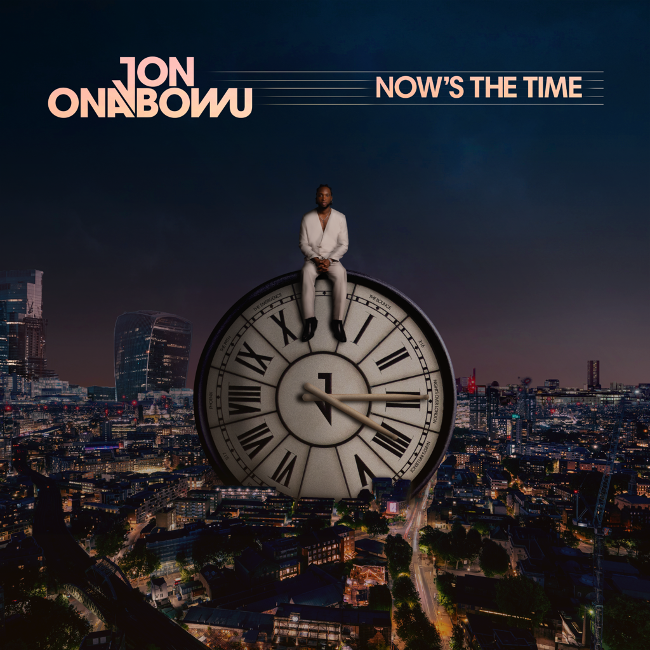
The title of British-Nigerian drummer, composer and bandleader Jon Onabowu’s debut album Now’s The Time feels remarkably fitting. As an artist who has toured and performed with a plethora of mainstream names in the jazz scene, including Theo Croker and the Balimaya Project, it seems that now really is the time for Jon to shine as a solo musician. On the eve of the album’s release, Onabowu discussed his journey towards going solo, the inspirations behind his work and the future of jazz as a genre.
Onabowu’s gentle modesty and respect for his musical contemporaries is undeniable. Discussing the key influences who have shaped the artist he is today, Onabowu stated that “the people who I wrote the album with, I genuinely enjoy their music as fans, not just because they’re my friends, they’re all amazing musicians, I just happen to know them”. But he was also quick to cite legends such as Herbie Hancock as huge musical inspirations: “I think he struck that balance really well of amazing musicianship, but also simplicity in what he was doing… his melodies are timeless, but the music is also very complex”.
The title of the album seemingly came to Onabowu some time ago. “I already knew the album was going to be called Now’s The Time maybe like two years ago…and I kind of thought to myself, there’s never been a better time in history for me to do the kind of thing I am looking to do”. It is refreshing to hear such frankness from an artist who is far more familiar with supporting other musicians than stepping into the spotlight himself.
What led to this chapter of Onabowu’s life as a solo artist on the cusp of releasing his debut album appears to have been a long artistic path of development. Speaking upon the album’s conception, Onabowu candidly stated that it was “more like a collection of songs that I wrote along the way… and then…I sort of realised…oh, actually, hold on, this works well as a complete body of work that I can put together to tell a story”.
Indeed, the tracks on Now’s The Time tell the story of what was on Onabowu’s mind when he wrote each one. One track which stands out for its deep transportive power and imagery is the third on the album, 'Nights Over London'. “I could actually see it as like you’re on the top of a hill, or you’re driving on a bridge in a nice convertible with the roof down in New York, walking through Brooklyn or something like that”.
Staying true to the live feel and improvised elements was of critical importance to the soundscape which Onabowu aimed to achieve on the album. “The way that we put it in terms of the structure and order, we did it so that when we perform it live, the plan is to perform the whole album. Some of the people I’ve played for in the past have very much been like, the album is one way and then you kind of pick and choose which songs you’re going to do, whereas I wanted it to be as close to live without being live.” And the album definitely does achieve that "live" soundscape. Driven by improvisation, the tracks combine the vigorous energy of a live band with rich use of harmony and strong rhythmic drive.
Speaking on the influences behind the album’s sound, Onabowu voiced that “someone else said, oh, this reminds me of early-days Snarky Puppy”, a five-times Grammy--winning American jazz fusion band. “I guess the spirit of what I’ve taken from Snarky Puppy is they make complicated music that still feels really good. The musician can enjoy it because it tickles that complicated urge that we have, or it scratches that itch.” However, the album is indisputably Onabowu’s own uniquely crafted sound. “I couldn’t really figure out who it reminded me of. It just kind of felt like my project”.
Yet the album also arguably forms an important work in a musical renaissance era where UK jazz appears to be undergoing a more inclusive rebrand. Onabowu opened up about the importance of blending the technical elements of a good track, whilst “opening the door into contemporary jazz for people who don’t see themselves as jazz listeners... the average listener could still listen to it and not feel like ‘this is foreign to me’.”
Onabowu clearly articulated elements of the music which were deliberately inclusive: “I wanted the complication to come more in the harmony, solos and improvisational die, rather than time signatures and things like that.” This also comes partly from the fusion elements of certain tracks: “'Phoenix' takes drill music which is a very contemporary genre... I wanted to take familiar soundscapes and then merge it with the spirit of improvisation and actually giving musicians a chance to shine and solo for longer than sixteen bars.”
On the note of inclusivity, and as a member of the Youth Advisory Board at Manchester Jazz Festival, I asked Onabowu what we can do to make jazz more inclusive to younger audiences. “Probably doing a bit more of what I’ve done”, he states. “The struggle that jazz has is that the purists don’t want to leave the 1950s and sixties, rather than realising that was the contemporary music of their day, and they were taking what was around and influencing them and making something out of it.”
He admirably spoke about making the genre more intelligible to unfamiliar audiences: “we live in an age today where people listen to things like rap, and if you can merge that with something that’s more complex harmonically, or push the boundaries rhythmically, that’s still in the spirit of jazz and that’s okay to do. You can save all the crazy stuff the for live performance and the live show. Let the album be simpler and easier to digest to draw people in and then you can wow them live”.
The interview also marked two days before Onabowu’s debut performance at Manchester Jazz Festival to perform an afternoon set at Band on the Wall. Speaking on his connection to the Manchester Music scene, Onabowu stated that “the music side of Manchester I know is more on the gospel side than the jazz side”. He also opened up about his love of Jazz Jams: “It’s going to be interesting going up there and seeing what’s happening… I love that when I’m in a city if there’s something happening like a jam, I always like to go and just kind of see what the actual local talents play”.
Manchester Jazz Festival aims to champion contemporary jazz artists and audiences, particularly from the north. Onabowu candidly spoke about his love of Knats, a Newcastle-based jazz quintet led by two best friends alongside a trumpet player. According to him, Reuben James, a Birmingham-based jazz virtuoso is “absolutely killing it too”. And Onabowu’s reflection on the wider jazz industry in the UK also feels incredibly relevant. He credited artists such as Yussef Dayes and Ezra Collective as those driving the idea that “London’s now starting to be seen as one of the major jazz hubs globally… people paying attention to us coming out of London”. For him, it’s all about championing UK jazz, or in his words “making jazz a lot more popular than it currently is”.
Perhaps the thing which is striking about Onabowu is how he thoughtfully balances deep appreciation for the genre of jazz, whilst openly embracing the delights of its modern fusion elements. In addition to solo career, Onabowu also has a residency at the world-famous Ronnie Scott’s Jazz Club in London called Cosmic Fusion, which invites a collective of "young, talented and fired-up musicians" to present their musical abilities through jazz fusion to wider audiences. “I’ve rearranged a lot of the songs (for Cosmic Fusion) now, so I’d love to do an album where we basically play our arrangements of those songs… I think that would be really cool”.
Onabowu’s dedication to opening up jazz to audiences and inspiring a new generation of musical talent in the UK is undeniable. The interview provided a key insight into how he aims to achieve this through both his newly founded career as a solo artist, and in his wider endeavours to serve communities musically. If Jon Onabowu’s artistry comprises the future of jazz in the UK, then the outlook for the genre certainly looks like a bright one.
https://open.spotify.com/album/6q3U06MC8CuWPSrkgNynyp?si=wD-cM2lzQ_C9_RhlizMemQ
Comments
Powered by DisqusComments are provided by Disqus.