
With voting for LeadMCR 2026 well underway, The Mancunion asked your candidates where to place themselves on "sliding scales" on different policy questions.
These issues included how the SU should approach its relationship with the University, as well as how politically active it should be, membership of the National Union of Students (NUS), and whether to prioritise student voice or learning support.
It should be noted that out of the 27 prospective officers polled, one-third of the candidates were not aware of what the NUS was. The NUS is a national confederation made up of roughly 600 students' unions up and down the country. It aims to give a voice to the national student community, and campaigns on a number of issues.
In March 2026, students at the University of Manchester will vote on whether to remain a member of the NUS.

The above image demonstrates the positions of candidates standing for Union Affairs Officers (Blue) and Wellbeing and Liberation Officer (Yellow) roles.
In terms of the SU's relationship with UoM, most candidates tended towards a somewhat combative relationship with the University, while almost all candidates agreed that the SU should be a politically active organisation.
Meanwhile, on NUS membership, candidates were more split. The candidates standing for the role of Wellbeing and Liberation Officer were decidedly more pro-leave, while Union Affairs candidates were more evenly distributed.
However, the overwhelming majority of candidates tended to lean towards an emphasis on giving students a voice over supporting learning, though to differing degrees.
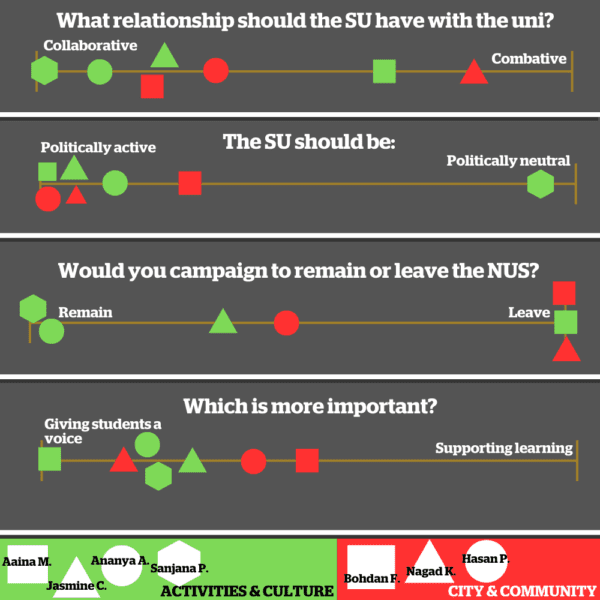
Unlike candidates standing for Union Affairs and Wellbeing and Liberation roles, candidates for Activities and Culture (green) and City and Community (red) tended to be more in favour of a collaborative relationship with the University.
However, similarly to Union Affairs and Wellbeing and Liberation candidates, those running for City and Community and Activities and Culture overwhelmingly supported a politically active SU.
Again, candidates were split over the question of NUS membership, with some candidates taking a somewhat neutral position, while others were firmly in favour of remaining or leading.
Despite this, candidates were generally in favour of a broad focus on giving students a voice, though some were more neutral between this and supporting learning.
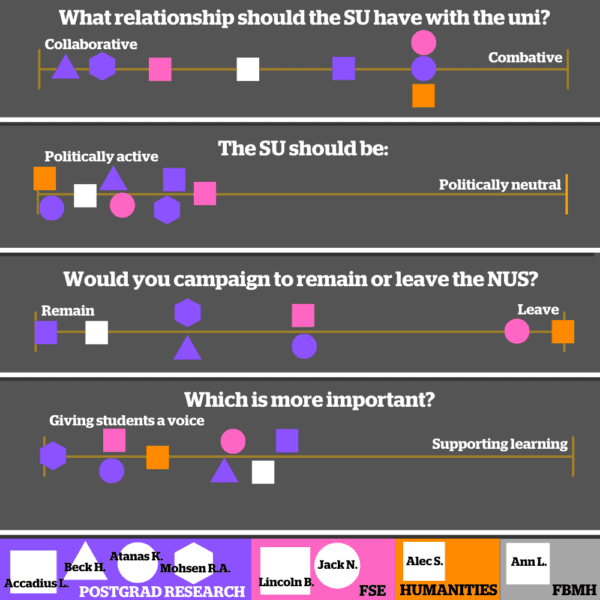
Amongst those standing for Faculty Officer roles, and Postgraduate Research Officer candidates, prospective officers were broadly evenly distributed between collaborative and combative stances towards the University.
However, it should be noted that no candidate placed themselves as completely backing a confrontational relationship.
As with the other roles, candidates were broadly fully in favour of a politically active SU, and again were split over NUS membership. Similarly, PGR and Faculty Officer candidates tended towards giving students a voice as a priority, over supporting learning.
Comments
Powered by DisqusComments are provided by Disqus.