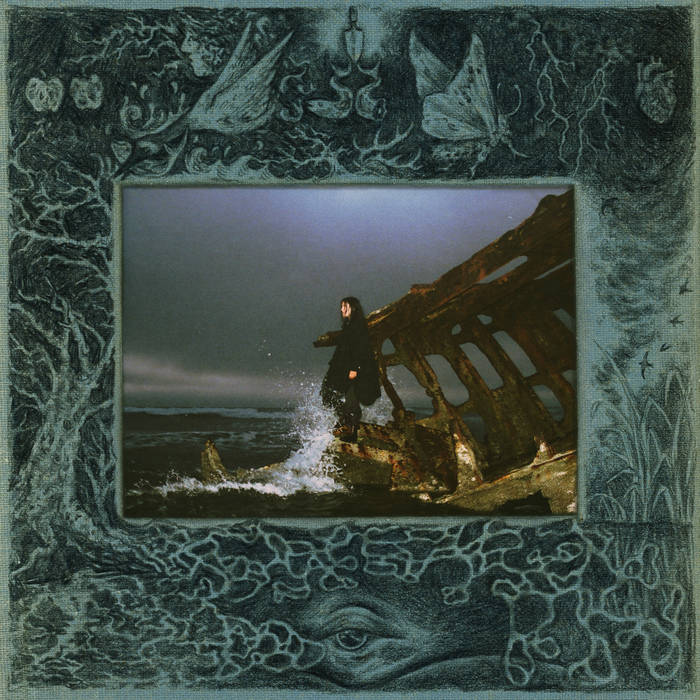
Alec Duckart, under the name Searows, caught himself in the tidal wave that TikTok was amplifying in the post-COVID world of new music. Posting demos online inspired by the likes of his poetic once-idols, now-contemporaries like Phoebe Bridgers, Sufjan Stevens, and Ethel Cain, he found himself magnetised by the beautiful harmonies emanating from the booming indie-folk scene — soon in a way that was near inescapable.
In the years of his blossoming, uniquely digital music career, Searows has been inextricably likened to his inspirations, opening for Ethel Cain's 2023 Blood Stained Blonde shows and making their sonic likeness ever the more concomitant. While this has proved a successful association, it's not always the numbers that matter, and this comparison has the potential to become a cage. Duckart has carved out a sound, a visual, and a career that, yes, has an undeniable likeness to his motivators, but also has an empathetic, relatable underpinning that really should be celebrated on its own, no better seen than in the recent release Death in the Business of Whaling.
Few artists are able to conjure a sound that sounds unbelievably alike the image they present; think the mysterious, atomised beauty of King Krule's Space Heavy, or the cold, plaintive mystique of A Moon Shaped Pool. Searows channels an audiovisual depiction of the sea. Tracks carry something haunting about them, as if they're a ship sinking under the unbearable weight of wood rot and heartbreak amid an ocean of dead, empty black. The vista of the cover, a lonely gaze onto an endless sea, is felt more than it's seen, unearthed in the delicacies of soothing banjo melodies and rich lyrics born of Duckart's poetry.
'Belly of the Whale', the opening song, grants entry into a heart all-consumed by the melancholy of our microscopic imprint on the world. A chronology of our perceived vulnerability to the forces around us, and the ocean waves warping us every step of the way. It all feels like an ode; a declaration of ourselves to the beings in control as our narrator "sink[s] into the grey" of a long-felt reality. We're serenaded out by resonant strings blurring the lines between beginning and end, also deeply siphoning the heart of the closing track to his 2024 EP flush.
Subsequent tracks like 'Photograph of a Cyclone' or 'Dirt' reiterate the struggle of accepting our ephemerality: the unrooting of forgotten memories, the consequent human need to self-destroy our connections with anticipatory comfort in the replacement coming next. The album chronologises both our and Alec's own chase for anything real before we return to the dirt, "solid enough" to make us feel like our place in the world leaves a mark that the tides can't take away. There's a pretty clear (yet nonetheless powerful) metaphorisation of the sea as the flows of fate, sending us into an unknown trajectory we're unsure we can ever cope with.
The ongoing personal narrative isn't out to solve problems — if anything, it's confronting us with new ones entirely — but instead to give some musical comfort to uncertain reality. Hope, even if it is nothing but peaceful delusion, is here something to live by anyway. Lead single 'Dearly Missed' depicts the story of a man who "by some sort of coincidence... drove his car off the river bridge" in heartbreak. Even his onlookers, embroiled in the same struggles, find a solitude in him, as if given the drive to live on to carry his existence with them.
Still, the story isn't only conjured in the written word. Instrumentals progress in a barely readable yet ever-present harmony before breaking out into explosions at a point of transformation. The most salient details in what Searows is trying to convey are nestled within the loud electric guitar solo to close out 'Dearly Missed', or in the synthic rhythm of penultimate 'In Violet' that sounds like a soundtrack to the passing of time. The sound is subtle but beautiful, arising from beneath the voice at poignant moments as if it's a score to the defining characteristics of human existence.
Duckart and producer Trevor Spencer create a multi-instrumentalist heaven that can only crash like waves once it resurfaces from the briny depths, largely leaving Alec's vocals to take the stage for the majority of the runtime. Songs often collapse into mesmeric, musical flashes of lightning, lingering only long enough for you to feel what they orchestrate before they're cast off into the abyss, or inevitably into your playlist.
Just as these songs seem ostensibly sad, heavy, and lyrics-driven, the surging arrangements given by a subdued guitar or through the comfort of swaying chord melodies provide something worthy of carrying in our headphones beyond merely the album context. The singles, particularly the aforementioned 'In Violet' or 'Junie', deliver oscillating beauty in their compositions, bringing in the effective simplicity of electronic or mechanic keyboard melodies acting as a dynamic backdrop to the mostly acoustic-led, singer-songwriter nature of the album.
Soon enough and nine tracks deep, we escape from the sinking reality of uncertainty into a solution which isn't always easy, but is right: "you do not have to do good, but you cannot do nothing". The closing song 'Geese' insists upon facing our destination even if we have no idea where the water might be taking us. Searows affirms that trying to find anything is better than being lost at sea. A reality where we go down with the ship, because maybe sinking will bring us out anew, reforged, stronger. There's a persistent idea that, beyond all this, we "come back", told in the refrain that brings the album to its apt end.
Death in the Business of Whaling is an album that proves itself. Sure, the constant comparisons to the big leagues of indie-folk can't be bad for business, but they're reductive in the way they homogenise the Searows sound. Beneath the amazing vocals that admittedly warrant a double-take to make sure Bridgers isn't a part of this solo act, there's an undeniable talent in reifying our existential, emotional worries into sweeping, unique instrumental pieces or poetically moving sentiments that make you feel seen just as much as human. Duckart's musical prospects are something that deserve to be absorbed by the indie lovers, made adjacent not just in likeness, but in quality and full-bodied, composite meaning.
https://open.spotify.com/album/5bqWbWR0tokA3hQio9h5cl?si=I-z0_wNwTIGkMkkptp8RZw
Comments
Powered by DisqusComments are provided by Disqus.