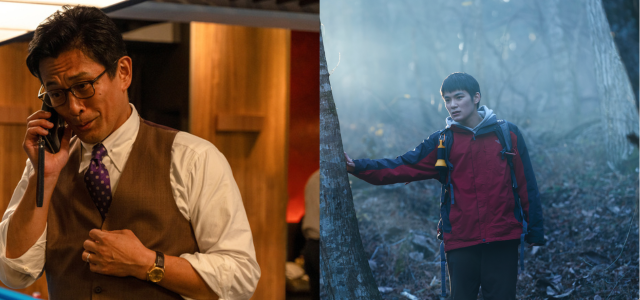
In its 23rd year, the Japan Foundation Touring Film Programme is launching its biggest Manchester line-up to date. The programme, which acts as a touring festival bringing a curated line-up of the best of Japanese cinema to 34 venues across the UK, is taking place at its usual Manchester stop, HOME. This year, it is also expanding out into two Greater Manchester Stops, Altrincham and Leigh. The festival's programmer, Junko Takekawa, talked me through the festival’s history and the decisions behind this year's programme.
“It wasn’t actually our initiative, but those venues came to us,” Takekawa tells me about the new Greater Manchester locations. “They came to us saying they want to take some of our films this year. It tells me how enthusiastic people in Manchester are towards Japanese cinema.”
The programming is a “painstaking process.” Instead of the submissions-based process many festivals work from, Takekawa tells me that she selects from the entire roster of Japanese films that are theatrically released. “In Japan, more than 400 titles are normally released. I can’t really watch 400 films so I have to select and narrow down based on reviews by the journalists and by the audiences.”
From this, Takekawa watches between 70 and 80 films which she then narrows down to 26 for the final line-up. The thought process behind the selection is “not just only on merit of quality, but also the variety of the content. I’ll try not to just focus on the films with social issues, but also more comedy, or horror mixed with hard hitting artistic works.”
The sense of variety is highly prized by Takekawa: “I’ve noticed that films that are very well received on international film circuits are not necessarily going down well with audiences. And vice versa. A film that a festival director may not choose because it’s not seen as artistic enough, an audience may love. People want to see something heartwarming or funny which may never be picked by international film festivals.”
The overarching theme of the programme this year is The True Self, something Takekawa chose deliberately to be “very loose”. This allows her to maintain a strong variety of films, but also speaks to something she sees as vital in our current era. “The world is so polarized. You really have to identify yourself as to who you are. Otherwise, you'll be so swayed by other people's opinion.” She also speaks to the social media age as disillusioning us with our own sense of identity, saying “you can easily create a fake image, or your image is created falsely by others.”
We discuss the popularity of Japanese cinema in the UK (and the West more generally), something Takekawa believes has grown massively over the festival's 20+ year history, but still feels there is work to be done. “It's shifted, definitely. There was a surge in the 1990s where the big giants such as Takashi Mike or Kitano Takeshi were in the limelight. Ever since, they have been forerunners of the Japanese cinema scene. Of course, after that, Koreda and Hamaguchi came. But they are still a tiny minority of the big giants.”
Beyond just auteurs, Takekawa says that no matter how popular and well respected Japanese cinema is, “through the eye of the marketer, through the eye of the distributor, they only choose something they think is sellable. They do not pick a variety of titles and tend to stick to films or directors that have hit in the past.”
“But for me, the most important element is that we can tell different stories, with different voices and many different directors regardless of whether it's commercially viable. I think our job is always to expand interest in Japanese films and different Japanese filmmakers in the UK.”
Of the 26 films Takekawa chose for the final roster, each cinema who plays host to the touring film foundation chooses a limited selection to screen. In Manchester, HOME is showing 9 of these from the 12th February to 10th March. This contains much of the variety that the line-up wishes to present.
Ryota Kondo’s Missing Child Videotape follows the core tenets of what made J-horror explode internationally. A mystery surrounding a missing child in the woods and a series of unexplained videotapes, the film is very slow but atmospheric, creating a looming sense of dread that continues until its final moments. It shines when it fully uses analogue aesthetics, recalling staples of the genre like Ringu in a way that doesn’t at all feel derivative.
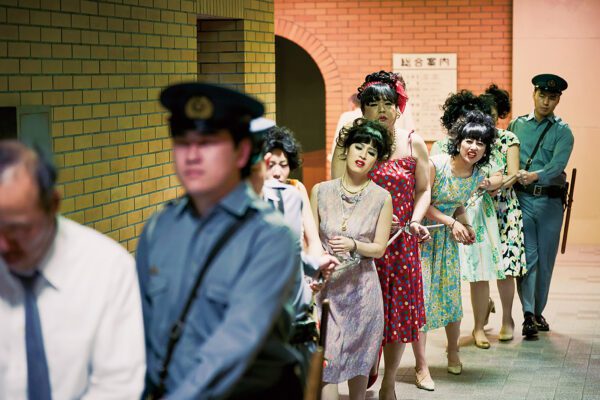
Another highlight playing at HOME is Blue Boy Trial, a very sincere and affectively performed dramatisation of a landmark legal case around trans rights in Japan. The film’s director Kasho Iizuka, one of very few trans directors working in Japan, will be doing a Q&A at the Manchester screening of the film, making it a must attend facet of the programme.
Credit - © 2025 Blue Boy Trial Film Partners
My favourite of the film’s showing in the programme has to be the spectacularly named Angry Squad: The Civil Servant and Seven Swindlers. Directed by Shinichiro Ueda (who also directed the wonderful One Cut of the Dead), Angry Squad follows a group of seven (as you may be able to guess) swindlers who recruit a civil servant to their cause to pull a heist on a businessman who owes millions in tax that he has evaded.
In very Ocean's Eleven style, the characters are all distinct and well drawn, and the swindles themselves are ridiculously fun to watch. It is the exact sort of blockbuster filmmaking that doesn’t get picked up on the more prestige-based festival circuit, so catch it while you can as part of the Touring Film Programme.
Tickets are available at the HOME website and more details can be found at the the Japan Foundation Touring Film Programme website.
Comments
Powered by DisqusComments are provided by Disqus.