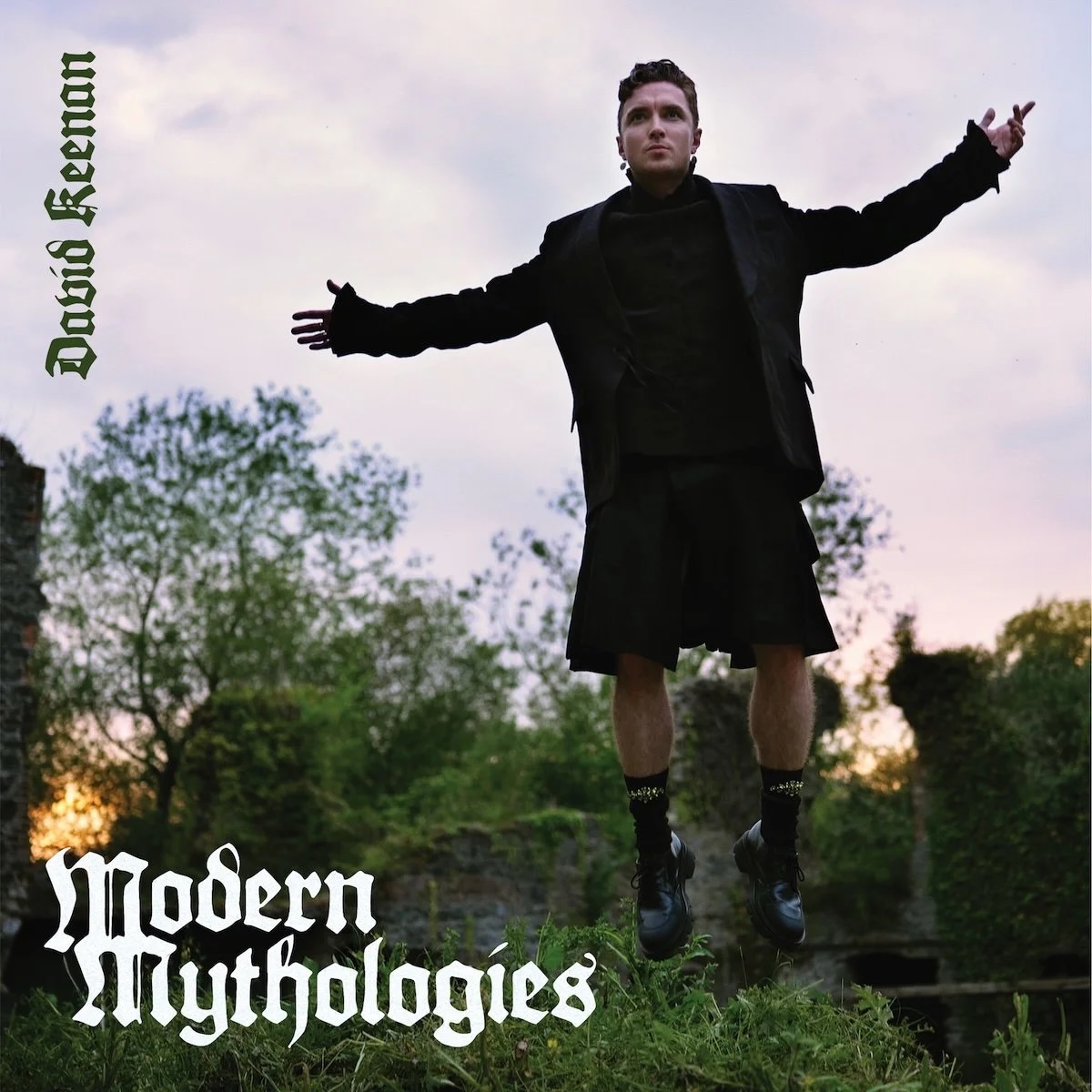
I first saw David Keenan eight years ago. He was the first support act of three for a small band, in a very small venue. I watched this figure with an acoustic guitar take to the stage before a handful of people. I've been listening since.
Now the Irish singer-songwriter arrives at Modern Mythologies, his fourth studio album, venturing beyond those early beginnings into something more ambitious and cinematic. An album of contrasts — jazz-funk meets indie rock meets electronic beats — yet it remains unmistakably David Keenan. Rooted in folk whilst embracing genre-crossing experimentation, it is anchored by his distinctive voice and trademark balance of the almost-cryptic, with visual scene-setting detail. His lyrics stay poetically astute and authentic, capturing restless creativity with unwavering honesty.
The album opens with 'Amelioration' bringing effortless mid-afternoon jazz bar vibes, immediately intriguing against Keenan's folk roots. Cuban trumpets, funk, and soul influences set a bright, warm scene that carries into the more acoustic '50 Quid Man', where he balances lyrical wordplay and vivid street-poet imagery with a smooth near-the-sea feel. By 'Suriname or Bust', Keenan begins to paint the contrasts that define the album. He dabbles in the surreal, "I walk in the shadow of the sky, resembling a collapsed lung", before the song explodes into one of the album's brightest moments — a euphoric chorus with a soaring major key against lyrics of wanting to leave. It feels happy-sad, like smiling through tears.
With the glorious 'Radiate a Smile', the album truly hits its stride. Keenan delivers one of his carefully penned yet seemingly off-the-cuff lines: "Power is reaching a place where no one needs to know I'm empowered". It's a perfect example of his distinctive self-awareness, bold enough to be sensitive. Like a street-corner commentator, he observes the frantic world around him —"people rush and push, everybody's rushing, and pushing and vying, vying to be heard" — before the claustrophobia melts into lightness in the chorus, like the sun emerging from the clouds. It's here that the album begins to soar, showing Keenan's ability to craft songs that travel, distilling interwoven tales into a compact narrative.
In 'Lives Left Out to Dry', acoustic guitars return to the jazz bar from the album's opening, only now it's near closing time. Where 'Radiate a Smile' lifts you up, this leans in close to tell a tale. The opening line, repeated as a closing refrain, delivers one of the album's most peculiar but brilliant moments: "When Dodger left, Susan stopped caring, she died quietly watching Strictly Come Dancing". It embodies insignificance, an emptiness, clutching at glamour amid bleakness. Uncomfortable, not dramatic but fateful, with Morrissey-esque kitchen-sink storytelling.
'Romantic in Me' reveals layers of mythology captured by the album's title. "The romantic in me is looking for a place to go for a while where titles and tinsel mean nothing" sits between optimism and delusion, sketching a world built on surface and show. We cling to an idealised version of reality to escape a world itself built on façade — yet in this imagined place, these illusions "mean nothing," exposing how much weight we give them.
By the second verse, even the self becomes something to escape, suggesting our identities are shaped by partial truths. The "childhood friend coming back from the dead to look you in the eye" feels like a former version of yourself resurfacing, unsettling to confront. The chorus bursts into bold atmospheric guitars before drifting into a dreamy soundscape, where Keenan asks: "How can you wake up if you don't even know you've been sleeping?"
'Copper Vat continues' this exploration with a Chris Isaak 'Wicked Game' feel, gorgeously close and steamy. Celtic melodies mix with Shangri-Las drama as Keenan grapples with "my own inspired lies", as if trying to articulate something when its precise details elude him. It feels like a stream of consciousness, the way your mind draws connections on the edge of sleep.
'The Fool's Gold' brings light relief with its country sound evoking open roads and sweeping plains, sunny but reflective. Breezy indie guitars carry California warmth, breaking the tension before 'Rebel Tune' turns heavy again, led by piano. "I need you to love me like I deserve to be loved" opens a yearning ballad that wouldn't be out of place on a Lana Del Rey album. Minor-key yet expansive, it depicts hope amid sadness with production reminiscent of Last Shadow Puppets love-on-the-edge-of-heartbreak, 1950s-style dream-pop.
The album takes a bold turn with 'Poison Water' — electronic elements, scuttling drums, and a repetitive dance beat and bassline achieve a much bigger, crowd-ready sound. Layered echoey vocals speak of a "big man in a balaclava" and a "hard man in a Ford Cortina" as Keenan examines his youth in the under-the-surface turbulence of post-Troubles Ireland. The trance-like jumble of sounds mirror a disorientating experience while warm guitar contrasts with "give me your hands they're freezing" — sonic temperature reflecting a conflicted society. An ethereal, synthesised refrain acts like an outpouring of pent-up angst and confusion: "Turn my feelings into poems, then I don't feel so alone".
'We Live, We Learn, We Love' feels like waking the morning after the previous track's immersive trance. A highlight of the album is this song's rap section where Keenan spits out commentary on culture, society, and self-perception as he delivers a cutting analysis of the "bittersweet sound of a conflicted nation". He blends literary reference and everyday observation, rhyming "raging soul like a Dylan Thomas" with the colloquial "let's be honest", whilst exploring success's paradoxes and the space between imagination and reality. Here he captures folk's essence — the stories of normal lives — and modernises it into something darker, scathing and sharp.
The album closes with the melodic 'Incandescent Morning', which offers a quiet moment after the rage outside, channelling the hymn-like cadence of his earlier cover of Leonard Cohen's 'So Long, Marianne'. "The fame came too quick, was like a pick n mix" captures vulnerability through the childlike pull of sweetness against the complexity of experience. Keenan's singing has always been strong, but here it soars.
As the album's longest track, it breathes and meanders — a welcome sigh, a release after the tightness preceding it. Its simple arrangement finds his earlier self after a journey through diverse styles, like looking through windows into self-contained worlds before ending at your own front door.
Modern Mythologies marks a fascinating evolution for Keenan. The title reveals itself gradually as he examines how we construct narratives — myths layered upon myths. The juxtaposition of "modern" and "mythologies" mirrors the album's contrasts: intimate and expansive, folk-rooted yet boldly experimental. Vivid and filmic, it unfolds like an anthology of stories connected by recurring themes and sonic echoes. It glows warm throughout, reflected in the language — radiate, copper, gold, incandescent, bonfire, sunny — an album lit with orange hues. Though the production shifts and influences grow, it embodies what folk music fundamentally is: honest storytelling delivered with raw intimacy.
In an increasingly commercialised industry, Keenan walks his own path at his own pace. This album reflects that fierce autonomy and willingness to explore whilst staying true to core values. For those seeking artistry over trends, Modern Mythologies rewards close listening and marks the work of an artist unafraid to evolve on his own terms.
Comments
Powered by DisqusComments are provided by Disqus.