★★★★
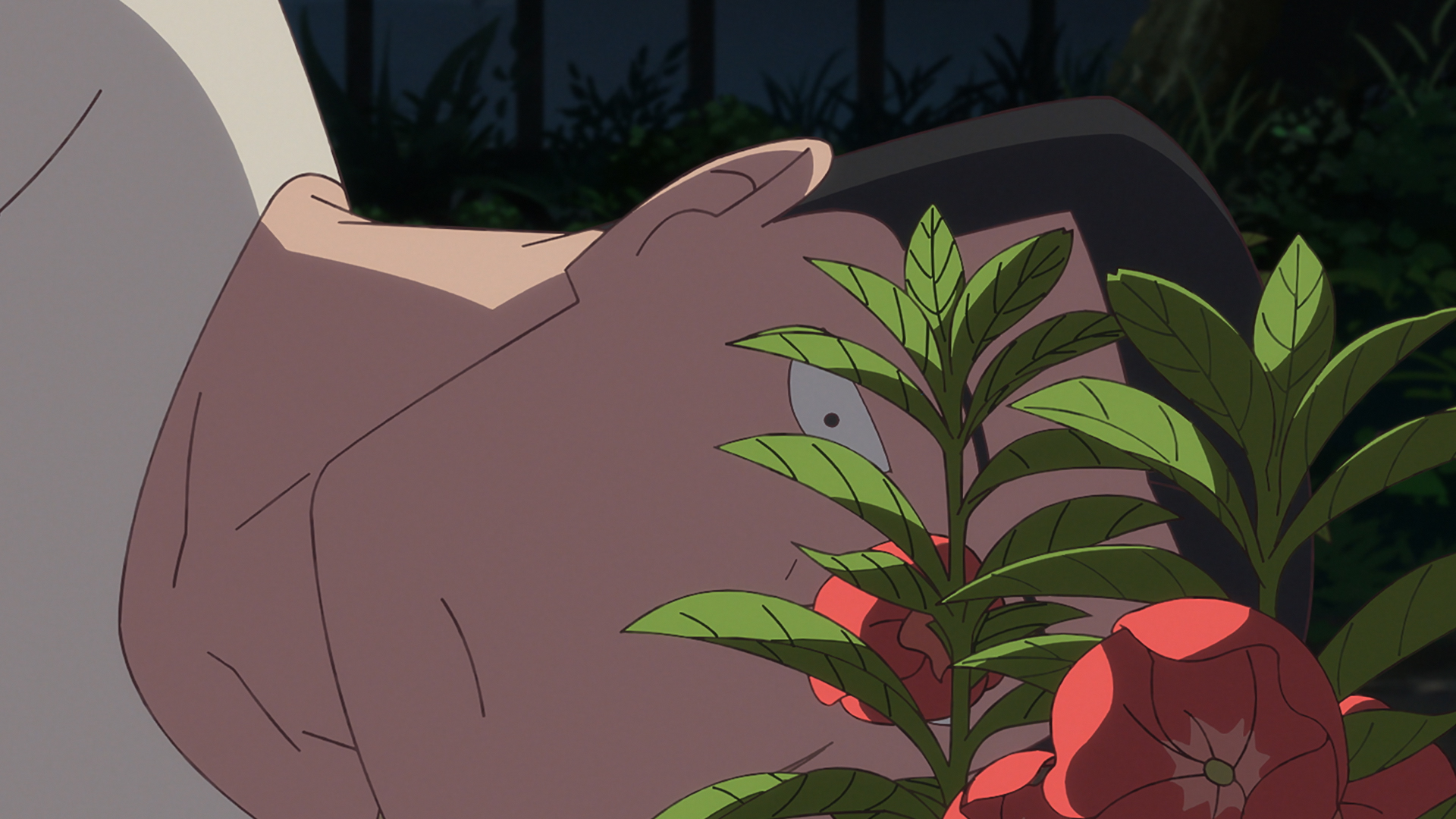
Minoru Akutsu’s laboured breathing opens the heartfelt Japanese film The Last Blossom. He lies in a dim prison cell, alone – that is, except for a sarcastic, sharp-tongued balsam flower who starts to speak to him. These are his last hours – “Only babies and the dying can hear me”, the flower tells us matter-of-factly – and so Minoru spends his final night dwelling on a life of failures and regret. The Last Blossom is a difficult watch if, like me, the thought of dying with misspent choices is terrifying to you.
We learn that Minoru was a yakuza (part of a Japanese crime gang) who kindly took in Nana, a young single mother with nowhere else to go. Minoru’s character design impressively indicates his personality. His large head, strong jaw, stoic expression, and mysterious scar make him a believable yakuza, but something still indicates a genuine heart that is absent from his slimy employer. Conversely, I felt like something was missing from Nana. Anime faces aren’t typically detailed but given the simple yet effective visual attributes of the male characters, she lacks something in contrast. You could put the same face on a teenage schoolgirl character without changing a thing.
Understated scenes of domestic contentment reveal that Minoru was in love with Nana. I wish there had been more exploration into her character because what we do know of her is very interesting, but their dynamic is a strong piece of the film nevertheless. One standout moment is their rendition of ‘Stand By Me’ using the ping of a microwave, the tearing of tape from cardboard and that low, recognisable ‘boum, boum, boum boum boum, boum’ which does a successful job of making us root for them despite the fact that we know he ends up alone. He never tells her, and, fearing her fate if she becomes the wife of a yakuza, they never marry. Instead, they lie inches apart on the same floor every night, years slipping by.
His unspoken feelings are one of many regrets the older Minoru recounts. Both a member of the criminal yakuza and acting (but often distant) father to Nana’s son, Minoru jeopardises his security through his own mistakes. The film manages to create a fleshed-out protagonist who struggles to balance an instinctive desire for self-preservation with reluctant but deeply-felt care for those close to him. The structure of the film poignantly presents the irrevocable consequences of every one of Minoru's decisions, good and bad; the balsam flower, it turned out, witnessed the lot. His blunt chastising of the older Minoru is more than comic relief: it ironically creates meaningful commentary, mocking the human tendency to overcomplicate our conditions or delay action. In the Q&A after the screening, director Baku Kinoshita spoke about how he was inspired by the flowers in Alice in Wonderland but wanted to move away from a likeness to Disney. Consequently, our balsam flower has no eyes or mouth, which means he has to be constantly in motion. This clever animation gives it a strangely humanlike quality and real personality.
The balsam flower is almost a cathartic stand-in for the viewer, an outlet for that rising but futile impulse to shake young Minoru by the shoulders and prevent his mistakes. Minoru is obsessed with the idea of ‘turn[ing] it around’, visually represented by the motif of the game Othello. His own definition of what ‘it’ is shifts throughout the film from money, security, safety, etc., and this adds to his characterisation in a very real way. This central theme of the film is successful in its portrayal of an unremarkable man who, like many, is perpetually chasing more while neglecting what he already has. Kinoshita thoughtfully handles his exploration into the importance of choice and consuming pain of regret; it is hard to reach the ending without thinking about your own life. The Last Blossom is an introspective film which gently champions honesty, courage, and the enduring power of human connection.
Comments
Powered by DisqusComments are provided by Disqus.