In 2018, Chinese director Bi Gan’s film Long Day’s Journey Into Night released in China, grossing a mind-boggling $38 million in just one day. To put this into perspective, this beats the opening day gross of: every Lord of the Rings film, Skyfall, Transformers, Harry Potter and the Philosopher’s Stone and Oppenheimer worldwide. However, the film only went on to make an extra $4 million in the entire rest of its release, and was despised by audiences, the hashtag ‘can’t understand Long Day’s Journey into Night’ trending on Chinese social media. Sold as a romantic date-night film perfect for its New Year's Eve release, the film is actually an extremely heady and avant-garde two and a half hour slow burn. While it is incredibly well-constructed, it is about as far removed from a date-night crowd pleaser as possible.
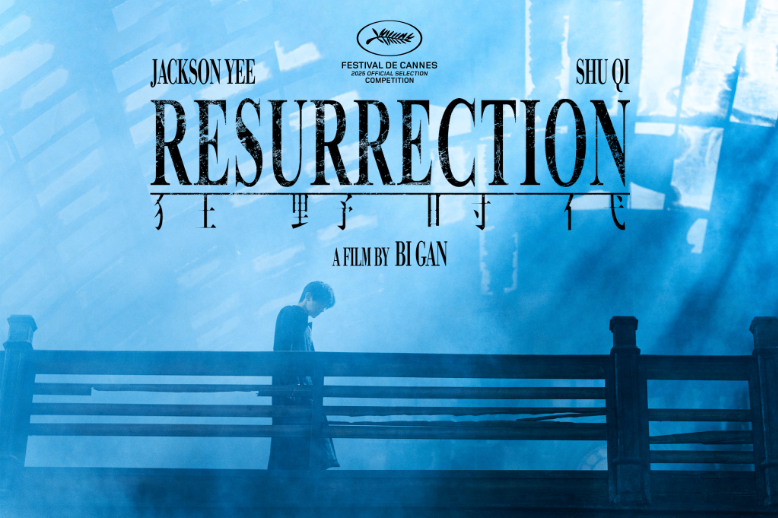
After 7 years, Bi Gan is back. Premiering at Cannes in May and playing recently at Leeds International Film Festival, Resurrection is a similarly difficult film to imagine being a large-scale hit without some kind of deception. But while there are similarities to his previous work, Resurrection is ambitious and sprawling in a way far beyond anything Gan has made before.
The film opens to a sepia-toned screen of text, akin to a silent film title cards, which lays out the premise: “In a wild and brutal era, humans have discovered that the secret to eternal life is to no longer dream! People not dreaming is like candles that do not burn - they can exist forever!” We learn that there are people who continue to dream, known as 'Deliriants'. However, this is the extent to which the film explains anything clearly. From this point on it is oblique and strange.
The opening section of Resurrection serves as a prologue, where a woman discovers one of the Deliriants. This whole section is beautifully constructed in a manner akin to the classic Universal monster movies of the 1930s. There is an abundance of beautifully painted and clearly artificial physical sets, with the Deliriant (played by Jackson Yee) caked up in prosthetics and make-up that completely obscure the human actor underneath. The centring of artifice and homage to past eras of film maps out what Resurrection will be doing for the entirety of its runtime.
The main body of its runtime is split between 4 anthology-like segments, each with a distinct style and energy. The first replicates the noir style, following a suspect in a bizarre sound related murder case, the visuals being steeped in shadows and darker visual tones.
The second segment, a highlight in the film, begins with a group of men who seem to be ransacking an ancient temple, before pivoting to a conversation between the only man who stays behind, and a being – who may or may not be his own tooth come to life – discussing enlightenment. Once again, this is shot with its own distinct style, the film it brings to mind most is (quite fittingly) Akira Kurosawa’s Dreams.
The fourth and final segment is the most impressive. It follows a young man and young woman (who might be a vampire) on a frenetic journey across a city on New Year's Eve. It’s all one single take sequence, something that can often come across as gimmicky given it's over use in recent years, but this is one of the most impressive examples of it I’ve ever seen. There are so many different factors at play: multiple locations, vehicles, stunts, animals, massive amounts of extras. It is a marvel to see it all come together in one take so seamlessly.
That isn’t even to mention the gorgeous lighting in this segment. The majority of it plays in stark red, almost monochrome, before switching its colour scheme entirely during a genuinely exhilarating violent karaoke scene.
Similarly to Gan’s previous film, anyone coming to Resurrection for narrative momentum may not be satisfied. Even the segments with the clearest plots seem to have little interest in the story. The formal aspects are clearly what Gan cares the most about and that care is deeply felt on screen.
The textual focus on dreams and the formal focus on cinematic history comes together beautifully. While not exactly the first to make the connection, Gan is presenting film as dream in a way could easily stumble into something aloof and irritating, but I don’t think it ever does. The clear passion and expert craft on display keep it just the right side of pretence.
Ultimately, Resurrection pulls off the impressive act of being a film about film that doesn’t feel too pleased with itself. It views film as important, vital even, but it never presents itself as such. Instead, it feels like a loving tribute to, as Gan puts it, “an entire century”, and an incredibly impressive one at that.
Resurrection played at Leeds International Film Festival and will release in the UK in 2026.
Comments
Powered by DisqusComments are provided by Disqus.