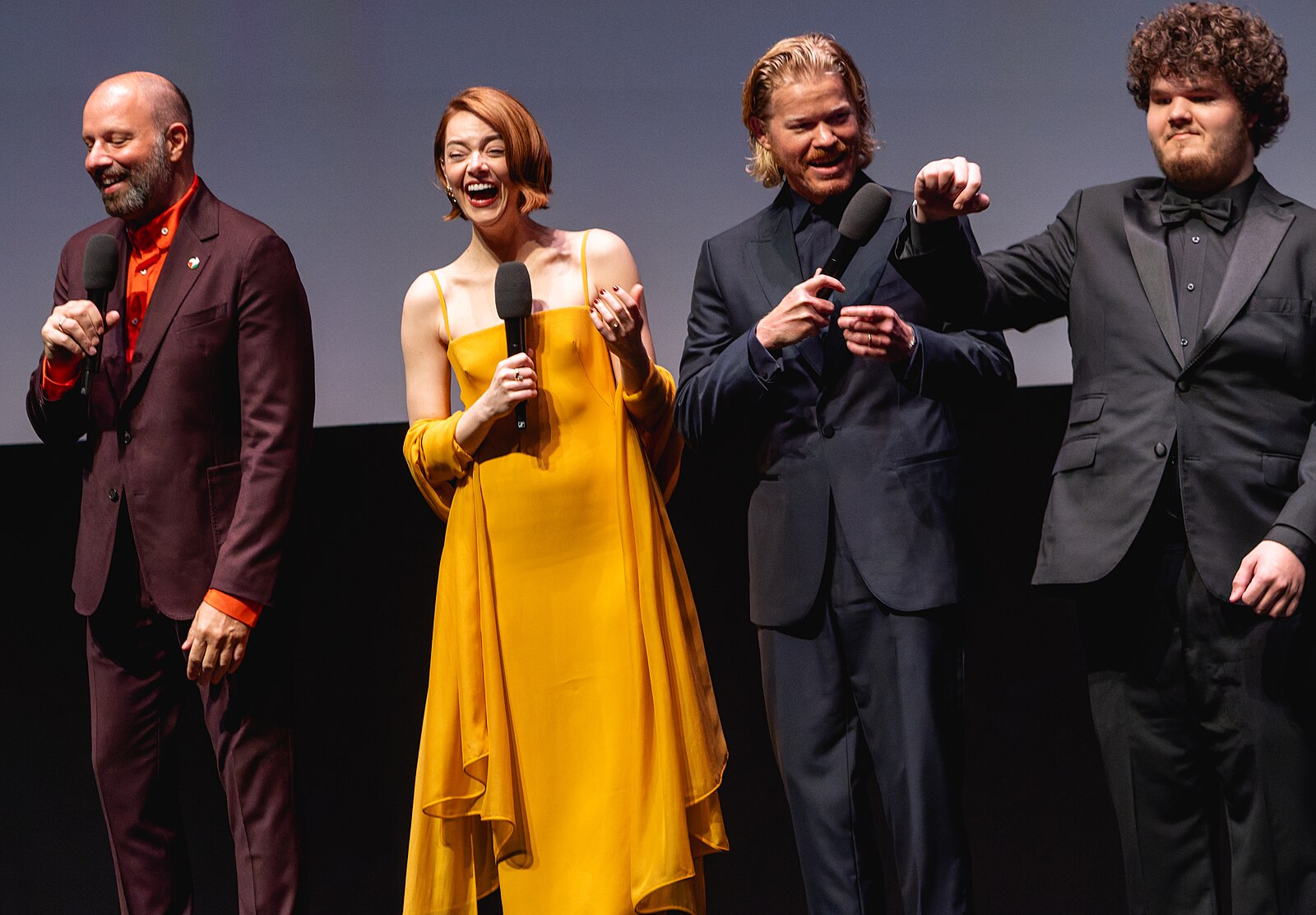
Disclaimer: this review contains mild spoilers for Bugonia (2025).
The Western political climate is one rife with speculation and conspiracy, regardless of scientific disproval. The COVID-19 pandemic is perhaps the most obvious recent example of mass public distrust in our authorities, even in situations as severe as global health crises, as proven by the massive uptake in anti-vaccination ideology.
Yorgos Lanthimos’ Bugonia better explores this political underbelly. It opens with conspiracy theorist Teddy (Jesse Plemons) outlining his plot to abduct pharmaceutical CEO Michelle Fuller (Emma Stone), on the suspicion that she is an alien intent on destroying the earth. With no evidence that Fuller is evil on either a supernatural or even human scale, we are immediately compelled to distrust Teddy.
Once he succeeds in kidnapping Fuller, Teddy shaves her head and covers her body in antihistamine cream, to prevent her from contacting the rest of her ‘Andromedan’ race for help. Again, Teddy offers us no evidence that Fuller has this ability, beyond the fact that he believes she does, and he becomes increasingly difficult to sympathise with. Any chances of redemption are lost, at least for me, when he subjects Fuller to electroshock torture, which he insists will confirm her identity.
Yet, while we are by no means expected to like Teddy, Lanthimos implores us to understand him. We discover through a flashback that Teddy’s mother was left comatose after participating in a failed drug trial conducted by Fuller’s company, leaving him distraught. Despite his efforts to seek reassurance from groups around him, whether they be Marxist or Neo-fascist, he fails to connect with them and becomes lost in his own head. It is only then that he turns to alien conspiracy, which I interpreted as an avoidance of the fact that he was truly alone, a refusal to accept the inherent selfishness of humankind. It couldn’t be one of his own who had incapacitated his mother. Fuller had to be something else.
Though Teddy’s political experience is a throwaway line in the film, I think it’s crucial for establishing his world as parallel to our own. We, too, are seeing an uptake in political division, with politics focusing less on improving our nation and more on vanquishing its enemies. It also explains his move to conspiracy: when the world he lives in solves problems by pinning them on an evil ‘other,’ it shouldn’t be surprising when he attempts to do the same.
But it would be in bad taste to depict Teddy as an innocent man influenced by the dark side of society. Lanthimos expertly underscores his story as a tragedy, but one that he was very much responsible for. We understand there might be a personal necessity in his abduction of Fuller, but this doesn’t remotely justify his previous murder and dismemberment of other women he’d tested for the Andromedan genes, whom even he acknowledges were human all along. There is a reason for his delusion, but no excuse for his acting on it.
This becomes especially apparent when we consider Don (Aidan Delbis) - Teddy’s autistic cousin and his antithesis. Don supports Teddy’s plans at the beginning of the film, shaves Fuller’s head, and watches over her while Teddy works. Despite verbalising his wishes to find love one day, he allows himself to be chemically castrated to limit potential distractions. He goes to such extremes in the name of familial love that we wonder how Teddy ever felt so alone in the first place.
It's through Don that we eventually discover Teddy to be the very thing he claims to be fighting against. In his fear of human disconnection, he permanently deprives Don of any sexual capability. In his fear of alien control, he manipulates his intellectually disabled dependant into assisting him in a cause he doesn’t believe in. In his want for a loving world, he exposes Don to so much hatred that he feels his only escape is to commit suicide.
It's for these reasons that I considered Bugonia to be an incredibly insightful watch. It cleverly humanised even the most selfish and nonsensical people in our current climate, but never made excuses for anybody who didn’t deserve them, and Lanthimos’ refusal to attribute these qualities to any particular political category allows room for a healthy amount of introspection.
Comments
Powered by DisqusComments are provided by Disqus.