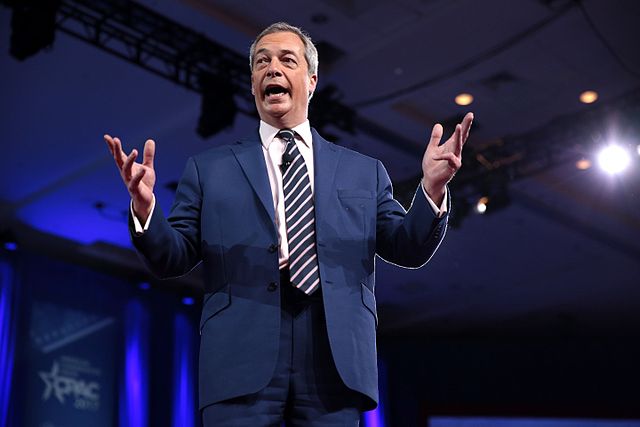
Recently, it appears there has been an increased use of the term ‘fascist’ directed towards Reform UK. Just last week, Green Party leader Zack Polanski appeared on BBC Question Time calling Zia Yusuf - Nigel Farage's top aide - a fascist on multiple occasions, and has since appeared on platforms such as the Jeremy Vine show defending his use of the term.
And 'fascist' isn't just being used by politicians on the left. At the annual Conservative Party Conference in Manchester a few weeks ago, Tory grandee Michael Heseltine ignited a scathing attack on Farage's Reform UK, likening the party to 1930s fascist groups.
This is not the first time that Farage's status as an apparent fascist sympathiser has been called into question. In 2019, a close school friend of Farage's stated that he [Farage] was "so proud at the height of Britain's far right movement that his initials NF also stood for National Front."
Why is the term 'fascist' increasingly being used?
It appears the label is now being ascribed to not just Farage, but seemingly his entire party, particularly regarding immigration policy proposals. Reform has suggested it would be prepared to deport 600,000 migrants over five years if it won the next election, and Farage added that his party would bar anyone arriving in the UK on small boats from claiming asylum.
As per the 1951 Refugee Convention, any signatory country (including the UK) is currently prevented from returning refugees to countries where they "face serious threats to their life or freedom."
This controversial policy announcement has been accompanied by accusations of Reform using inflammatory language to describe minorities. An undercover Channel 4 investigation recorded Reform canvassers making explicitly Islamophobic and racist comments, and the party has been accused of 'whipping up anger' and prejudice over recent asylum seeker hotel protests.
Indeed, in his attack on Zia Yusuf during the BBC Question Time debate, Polanski justified his label of Reform as fascist by claiming they had adopted a rhetoric of vilifying vulnerable people in society as perceived enemies.
However, it appears as though 'fascist' is now being thrown around rather rashly, and hence may be causing more harm than good.
Alienation of key voters?
The concern lies firstly in the possibility that using the term 'fascist' prescribes that label to Reform's supporters. Journalist Luke O'Reilly validly raised these concerns on the New Statesman podcast, stating that a lot of his supporters "hear when you call him a fascist, you’re calling what they would consider genuine concerns fascist as well."
It's no secret that Reform have managed to appeal to a vast number of working Brits, with a recent YouGov poll revealing that if an election were held tomorrow, a Reform UK government would be a "near-certainty."
Therefore, there is a real possibility that labelling Farage a fascist could alienate Reform's extensive base of supporters from other parties. For parties on the left, including Polanski's Greens, winning the support of working-class British people could be the difference between election victory and loss.
Trivialisation of the term?
The question also begs: can we veritably call Farage and Reform's views 'fascist'?
It is certainly valid that some of Reform's and Farage's statements carry with them a darker and more sinister political tone. In particular, their proposal to scrap the European Convention on Human Rights and their increasing identification of minorities as scapegoats for the effects of years of austerity are concerning.
But the party is not unique for the divisive narrative it appears to be conveying. Indeed, the Conservative Party have also committed to leaving the EHCR if they win the election, and the unbased targeting of various minorities is certainly not unique to Reform alone.
Additionally, however divisive Reform's political narrative appears, the party and its MPs are still operating within a democratic system. As journalist Ollie Dugmore recently stated, Farage "is now seeking elected office," and it does not appear as though any sort of "authoritarian enabling act" is on the cards for Reform UK.
The term 'fascist' has been used to describe some of the most unspeakable political regimes throughout history. Repeatedly prescribing it as a label to Reform and Farage risks minimising the term to merely petty name-calling. Therefore, it requires careful consideration before being used to describe politicians and policies.
Alternative language?
Perhaps for the moment, the term 'right-wing populist' could more appropriately describe Farage and Reform. The 'us-vs-them' narrative, a hallmark of populism, forms the backbone for Reform's narrative, particularly those pitting migrants as opposed to British values.
That being said, it is important to keep an eye on Reform UK and Farage; history informs us that the slope towards fascist regimes is a covert yet slippery one. The necessity of upholding British democratic institutions and norms seems perhaps as pressing as it will ever be.
Comments
Powered by DisqusComments are provided by Disqus.