Hamnet Shakespeare died in the summer of 1596, aged 11. And while very little is known about his life and death, the obvious connection between him and his father’s play, Hamlet, has fascinated critics for centuries. Zhao’s latest work, like the book that inspired it, endeavours to fill this historical chasm. HOME cinema previewed the adaptation as part of their screenings for the BFI London Film Festival, and it was met with a glitter of quiet sniffles and glowing wonder.
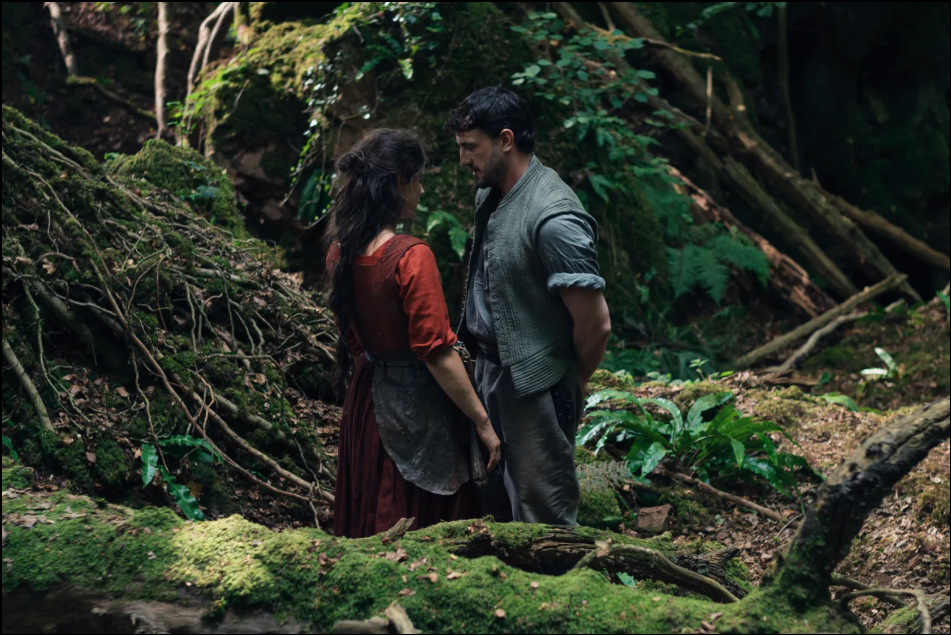
The film takes a while to get going. We are lured into a sense of stillness as Zhao stalks the unfolding relationship between Shakespeare and Agnes, played expertly by Paul Mescal and Jessie Buckley. Both actors almost immediately assert themselves as forces to be reckoned with, but the first act is predominantly uneventful and perhaps takes up more of the runtime than it ought to. Zhao lets us bask in the observational, candid style that she came to be known for through The Rider and Oscar-winning Nomadland.
Her attentiveness to nature is vastly complementary to O’Farrell’s original words, which are translated to the screen with an awesome affection that very few working filmmakers would be at all capable of. There is, admittedly, a scattering of ever-so-brief moments where this stark authenticity that Chloé Zhao has received such acclaim for seems to wane in favour of a more purposefully rousing style. This is not a film that needs to sell itself to us or remind us of what it is trying to do, and so moments like this come across as slightly clumsy, but still entirely forgivable.
From the very instant that Hamnet (Jacobi Jupe)’s face appears on screen, however, it becomes clear that the wait has been worth it. He is compelling and convincing in a way that I am not sure I have ever seen a child actor be. His time on screen feels so limited, but is unquestionably worthwhile and staggeringly moving. There are sharp silences that pierce Hamnet’s tragic life and give brief chances for audience members to wipe the brimming tears from their eyes before Max Richter’s score drags them by the waist back into Agnes’ world.
https://youtu.be/xYcgQMxQwmk?si=fLLvFQv-0i4zDm-E
I would nevertheless argue that, in spite of the wrenching talent that teems from the rest of the ensemble, it is Jessie Buckley’s red-raw performance that wields the weight of this film. Her ability to inhabit Agnes looks utterly exhausting and is comparable to no other cinematic portrayal of grief. Watching her in interviews from the film’s press tour, I struggle to fathom how she could possibly have a single drop of life left in her after this. Frequently, actors are described as ‘giving everything’ to a role, but I believe that Buckley takes this sentiment to newfound heights in Hamnet.
Narratively, Hamnet possesses an elusive sense of aimlessness throughout. Despite the constant anticipation linked to Shakespeare’s great name that is thread into the fabric of the episodic plot, the film seems adamant not to rush into the excitement of the tragedy that we know Hamnet’s death will stimulate. Thus, when the moment finally arrives, Zhao delivers one of the most moving and cathartic finales in recent cinematic memory.
Crammed in an undulating Elizabethan crowd, we watch the play through Agnes’s weary eyes. Noah Jupe, the older brother of the film’s starring child actor, gives a charged performance as the player of Hamlet at the Globe. He subtly echoes Jacobi’s boyishly hopeful and sorrowful mannerisms, reanimating the burdened child with a burning spark of life. His brilliance delivers the final emotional gust in this hurricane of a film and, sustained by the use of Max Richter’s On The Nature of Daylight (previously utilised to a similarly effective extent in Denis Villeneuve’s masterwork Arrival), solidifies this film as one of the greatest artistic re-enactments of grief that has ever graced our screen.
https://open.spotify.com/track/0tYuVSs2DqXhtXT4JzDWSt?si=359d20c856c04ea4
The final ten minutes are both frighteningly delicate and crushingly powerful, managing to draw together a wealth of working parts to form an adaptation that accurately captures and carefully redistributes the warmth and beauty of its original text. It would be selfish not to urge you, if you have not already, to buy a copy of Maggie O’Farrell’s spectacular novel and read it in time for this film’s release across UK cinemas on the 9th January 2026.
5/5
Comments
Powered by DisqusComments are provided by Disqus.