Between 9 and 12 October, Manchester hosted this year's 'The World Transformed,' a gathering of left-wing activists, groups and politicians for a number of talks, panels and events. While the main event kicked off in Hulme, the University of Manchester's Students' Union played host to Students Transformed, a fringe event focused on student activism and issues.
Our reporters attended, and have given their perspectives and opinions below:
Adella Tobing
The opening ceremony of 'The World Transformed' began at All Saints Park with a sense of anticipation and purpose. Drums echoed through the crowd as speakers rallied attendees, preparing to march towards Hulme — “Home to Mancunians and radical movements across the globe for years,” as one of the speakers declared.
Before setting off, organisers took to the mic to express solidarity with groups facing increasing hostility in today’s political climate. They spoke about the ongoing threats to immigrants, transgender people, and other marginalised communities, as well as the challenges faced by workers, renters, refugees, and climate activists. Closing on a powerful note as the crowd chanted in unison: “I believe that we will win.”
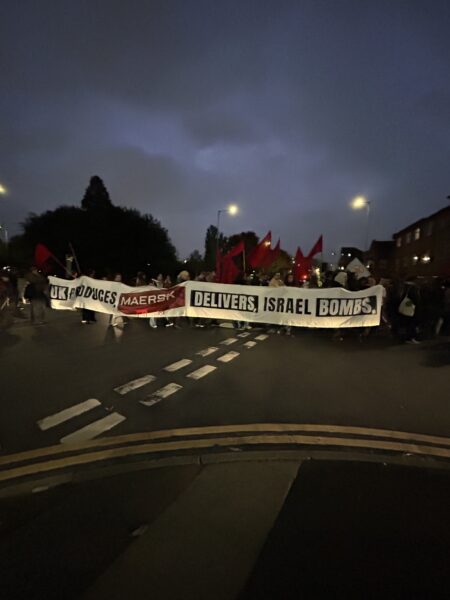
As the march began, the visual power of the procession came into focus. Large props and banners rose above the sea of people, each symbolising struggle and resilience. One of the most striking was an oversized key, a reference to those carried by Palestinians displaced during the Nakba in 1948. Another sign read, “UK produces, Maersk delivers, Israel bombs,” offering a sharp criticism of global complicity in violence. The march moved through Manchester’s streets to the sound of chanting, singing, and steady drumbeats; the mood was charged but hopeful.
Credit: Dan Hunt @ The Mancunion
When the procession reached Niamos in Hulme, the atmosphere changed. The fierceness of the streets gave way to warmth and reflection. Where the march had been loud and defiant, the gathering at Niamos felt intimate — a space for connection and conversation. The venue buzzed with chatter and music as people settled in for an evening of talks and performances.
Speakers from across generations and backgrounds took the stage to share their experiences of activism, art, and organising. Among them were representatives from Breaking Barz, a community-led anti-racist project that celebrates the life and legacy of Manchester’s uncrowned boxing legend and civil rights activist Len Johnsone. Founded in 2021, Breaking Barz has since showcased more than 80 artists and DJs across iconic venues such as Band on the Wall, Manchester Carnival, and Factory International — blending music, culture, and politics in a distinct, Mancunian spirit.
Upon returning the next day, the energy was still palpable. Stalls lined the venue, displaying handmade artwork, zines, and an array of radical left-wing literature. Between stalls, conversations flowed easily, about housing, Gaza, and student activism, over cups of coffee and the smell of food drifting in from the truck outside.
The sense of community that began in All Saints Park carried through every corner of the festival. From chants in the streets to quiet conversations at the stalls, 'The World Transformed' felt like a reminder that collective action, in all its forms, is still alive in Manchester.
Dan Hunt
The opening ceremony of 'The World Transformed' was a sight. Three snake-like effigies led the march from MMU, dancing and twitching on strings like something between a Chinese dragon and a dangling cat toy. The first figure was clearly Keir Starmer, the second seemed to be Shabana Mahmood, our new Home Secretary, and I couldn’t tell who the third man was. A marching band accompanied us as we walked and coloured smoke filled the air. The march ended at Niamos Theatre, a community space in Hulme which hosts jazz improv nights every week. A giant sign sat along the main road: “SOCIALISM”.
The ceremony was designed to represent the coalitions behind the modern left. Before we walked, a series of large, paper mache symbols were introduced. The march carried a key to represent the right of return for Palestinian refugees, a pigeon to represent tenants’ unions, and a boat to represent asylum seekers and refugees. There were also trade union banners and dozens of red flags.
Full disclosure: aside from the opening ceremony I only made it to one other talk at the World Transformed (of course, I caught a bit of fresher’s flu). I didn’t hear Zack Polanski, Jeremy Corbyn or Zarah Sultana speak, but the general mood amongst activists seemed to suggest that this was a good thing. I heard several speakers criticise “celebrity worship”, as they argued for a grassroots political culture less focused on party leadership.
The talk I did make was the Sunday Assembly, one of three events designed for mass-debate. Hundreds of people filled Ascension Church, Hulme to discuss organisation and coordination. The meeting was chaired by journalist Ash Sarkar, whose straight-talking attitude captured attention. Comments which stick out in my memory include “If you can’t be nice, be fake” and “To the man at the back who looks a bit like Colonel Sanders”.
After several speakers emphasised the importance of party representation for groups under attack, like asylum seekers, Sarkar asked speakers to consider the tension between speaking up for minorities and attracting “bald white men”. This sparked a debate about whether Your Party could convert Reform supporters, or whether it needed to focus on mobilising others.
Most notably, some local organisations put forward a motion designed to be the broadest possible consensus for Your Party. It included political messages like anti-capitalism, anti-imperialism, trans-rights and anti-racism. It also included plans to make Your Party “genuinely member-led”, including mandatory reselection for MPs, a democratic whip for decisions passed at conference, and the UK median wage for all MPs and staff. Almost the whole room voted for it; five hands were raised against.
Rosie Goffe
At this year’s 'The World Transformed' festival, two talks, Students Transformed: What Came Before Us? and Students, Rats and Rent Hikes, delved into the radical history of student organising.
The opening discussion looked at how student activism has inspired social change throughout history, from Vietnam War protests that challenged state violence to the millions who refused to pay Thatcher’s poll tax. The speakers noted how universities have long been transformed into political arenas, with walkouts and occupations becoming defining acts of defiance.
Audience members from across UK universities reflected on their own histories of dissent. From the 1915 rent strikes in Glasgow and the conviction of eight Cambridge students protesting the Greek regime, to pro-Palestine action in Manchester, the room was brought together with stories of resistance.
Yet, as the speakers noted, the same universities that now celebrate their radical past often punished those very activists; a pattern that continues today. Students supporting Palestinian freedom face disciplinary action and backlash. The speakers claimed that in some cases, campus architecture itself, such as Leeds’ Roger Stevens building, were even designed to deter the possibility of protest.
The second talk turned to the escalating crisis in student housing, led by speakers from Manchester’s Students’ Renters’ Union. The panel emphasised how, on average, halls at the University of Manchester have gone up by almost 40% above inflation. The audience also heard how disabled students often pay more for accessibility, while others face broken furniture, mould and even rats.
Rent strikes in 2020 and 2023 reflected a strong appetite for collective action, including the 46-day long occupation of the Simon Building that ended in court-ordered eviction. With 97% of students voting in favour for the Students' Union to support these rent strikes, the demands made by protestors at the time remain official SU policy.
The union framed the housing struggle as part of a broader fight against gentrification, where “luxury accommodation serves neither students nor residents."
In response, a University of Manchester spokesperson commented:
“Student housing has a variety of options across the city and wider region. The University provides accommodation choices at a number of price points and locations, along with our accommodation guarantee for all new undergraduates and international postgraduate students. We are also supporting students via our new accommodation bursary scheme. Manchester City Council has acknowledged an under-supply of student accommodation in recent years, and in doing so have identified capacity for additional purpose-built student accommodation sites close to the city’s universities. The University will support these developments in the right location subject to student affordability and wellbeing considerations.
“University-managed accommodation includes all energy, water, Wi-Fi, and 24/7 support from our Reslife and Campus Support and Security teams, and we provide a wide range of events and personal development opportunities. Some halls are catered, and cleaners visit twice weekly. Despite inflationary pressures, the University absorbs energy and food cost increases during the year and applies the lowest rent rises to the most affordable halls.”
The panel closed by encouraging those from other universities to set up similar renters' unions, uniting the struggle for affordable housing nationwide.
Reflecting on both sessions, it remains clear that students stand at the forefront of social change, continuing to spark the kind of collective activism that can transform society.
Claudio Mecklenburgh
Where is the hope for Britain's future? It has been a question at the forefront of debate during a moment in the UK’s political landscape where things seemed poised to change.
Over the weekend of 'The World Transformed' 2025 (TWT25), the streets of Hulme were a testament to the hope that can be found in community. The area has been home to working people vital to Manchester since the industrial revolution and has a rich history of political solidarity, from the sanctuary of Viraj Mendis in Hulme’s Ascension Church, to the 1945 fifth pan-African congress, held in Chorlton-on-Medlock’s then town hall. It is the kind of place that provides a reassuring assertion of the power held by grass-roots movements; a great location for a socialist festival.
TWT25 not only advocated for grassroots community organisation, but relied on it. The local garden centre, Niamos theatre, the Ascension Church, and Work for Change (a local co-operative workspace) came together to provide a network of venues and spaces for talks, stalls, pub quizzes and live music. People filled the streets and the local bars, and harboured amongst Hulme’s arts centres, housing estates, churches and local businesses was a real sense of community and an appetite for change.
Speaking at the Students' Union, Zack Polanski advocated for local, publicly owned renewable energy production and a “much more decentralised national grid." Meanwhile representatives of Your Party, including Jeremy Corbyn and Zarah Sultana, set out plans to “develop local political organisers long-term."
But they were not the only voices that were heard. At the general assembly in the Ascension Church, attendees and speakers provided collective input on the strategy, policy and values of a new left party. Resounding support was shown for exciting bottom up initiatives, with many speakers proposing that the new party should use its funds to provide services such as healthcare and social clubs to build a strong and unified movement.
Overall, I got the impression that TWT was not about the Greens vs Your Party or any of the big names on the left but rather about the consensus for a collective grassroots movement.
In the Ascension Church, this consensus was undeniable and it was not driven by political puritanism or the leadership of a few key figures. It was driven by the unity and organisation that allows communities not only to come together for each other but to stand up for justice globally. TWT made me feel proud of the people and communities I grew up with, and those of the city in which I study, rich in their diversity, history, compassion and strength. They are what makes me proud of this country. And they are where my hope for its future lies.
Ruby Filleul
"What do you think about the Green Party being founded by the Nazis?" one conference goer says to a friend as they wait for a cup of coffee.
This is the first snippet of conversation which I hear heading into day three of 'The World Transformed'. On the heels of the Conservative Party Conference in Manchester, this left-wing political conference landed in the city full of vim and vigour for a new type of socialism in Britain.
With stalls covering everything from the Supreme Court's ruling on the trans community, information about the latest news coming out of Palestine and renters rights, this conference seems to cover every hot topic for today's political left.
Attendees at the conference told The Mancunion they were "cautiously optimistic" for a new type of left wing politics, which didn't seem possible in the UK even just a year ago.
One of the headline events for Day Three was the Q&A with Zack Polanski, the new leader of the Green Party.
Despite taking place on a Saturday, the hall at the top of the Students' Union was packed, thrumming with anticipation for his arrival. This seemed to be a fitting testament to the man who has seen the membership of the party almost double in his short stint so far as Green Party leader.
From the moment he stepped in, it seemed that everyone in the audience had been well and truly "Zack-tivated", a term the Green Party Leader used jokingly at the start of the talk.
However, his focus throughout the session was not solely on the environment, as one may expect from a Green Party leader, but rather tackling inequality more broadly.
Telling the audience “you cannot be an environmentalist without caring about inequality," he went on to profess his own support for socialist politics.
Despite being only 35 minutes, Nigel Farage and his "Party full of fascists" were certainly central themes of the talk. Despite this, Polanski was careful to distinguish Reform politicians from their voters, and even went on to say that community energy "is how we're going to stop the far right".
“I can understand why people in this country are really angry" he told the audience, before shifting focus to students specifically "you’ve been screwed over, you’ve been lied to, you’ve not be offered appropriate alternative choices."
But one may assume that by "alternative choices" he is only referring to the Green Party rather than Your Party, another guest at 'The World Transformed'. Whilst Polanski admitted he does "really like" Zahra Sultana and Jeremy Corbyn, he doesn't think there is a place for another grassroots left wing party in British politics.
Judging by the reception he received, the Green Party is bound to increase its membership even more in the next thirty days as it establishes itself as an increasing political force in Britain's future.
Billie Minchin
On Sunday 12 October, the final day of political festivities for 'The World Transformed', I attended two thought-provoking discussions on behalf of The Mancunion.
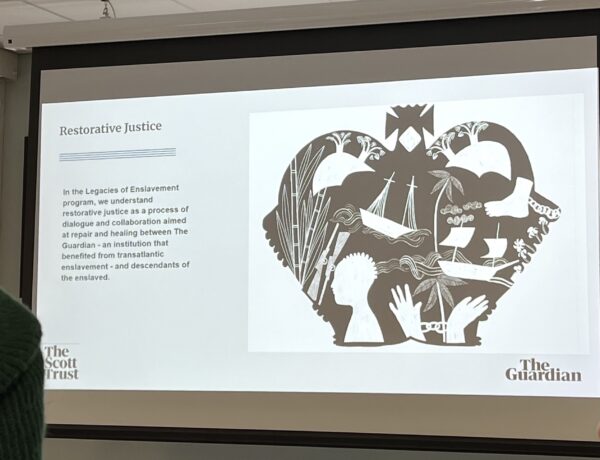
The first of these was 'What does reparative justice mean in this moment?' Hosted by Keisha Thompson from the Guardian’s Legacies of Enslavement programme and Eleanor Shearer, senior research fellow at the thinktank Common Wealth. This discussion posited that our world made by Empire is yet to be remade.
When addressing Britain’s imperial legacy in the Caribbean, Shearer drew on the 'boomerang effect' to stress that focusing on reparations isn’t a luxury, even in our current political climate. They argued not only is the impact of Empire ongoing overseas, but it continues to be central to our political infrastructure today.
This powerful sentiment was brought close to home by Thompson, who addressed the Guardian’s founding links to Manchester and the transatlantic slave trade.
When answering, “What does it mean to be a progressive organisation that was born out of the profits of human bondage?”, Thompson discussed the Guardian’s process of acknowledgement, apology, and action. It was inspiring to hear her thoughts on truth-telling as a foundation for collective healing.
Later joining the panel was Kobina Amokwandoh from PARISC (Pan-African Reparations Internationalist Standing Conference), whose insightful knowledge was marked by his belief that Pan-African reparations is the starting point for reparative justice.
Even while this discussion covered sobering topics, it felt encouraging to hear about how Manchester is part of a global conservation that we can all get involved in.
Credit: Billie Minchin @ The Mancunion
The other event I attended was called 'Resisting Digital Policing'. Since Prime Minister Keir Starmer announced plans to introduce a digital ID scheme in the UK, I’ve seen significant opposition sweep the internet. For this reason, I was keen to attend this next discussion hosted by Laurence Meyer, Dr. Seeta Peña Gangadharan, Zara Manoehoetoe, and Sara Chitseko.
Increasingly, this discussion stressed how technologies are operating not only in policing, but also in prisons, borders, employment, and welfare systems. Nevertheless, its starting point was: “How do people experience technology at the everyday level?”.
By reiterating our need to break-down technology and make it seem tangible instead of abstract, this discussion made clear that understanding digital policing is the first step towards resisting it.
I felt that, in sharing their professional knowledge, the speakers were intending to raise awareness and emphasise the need for shared understanding in today’s digital age.
Overall, my experience of 'The World Transformed' certainly aligned with its aims of encouraging community-building and grassroots action.
Comments
Powered by DisqusComments are provided by Disqus.