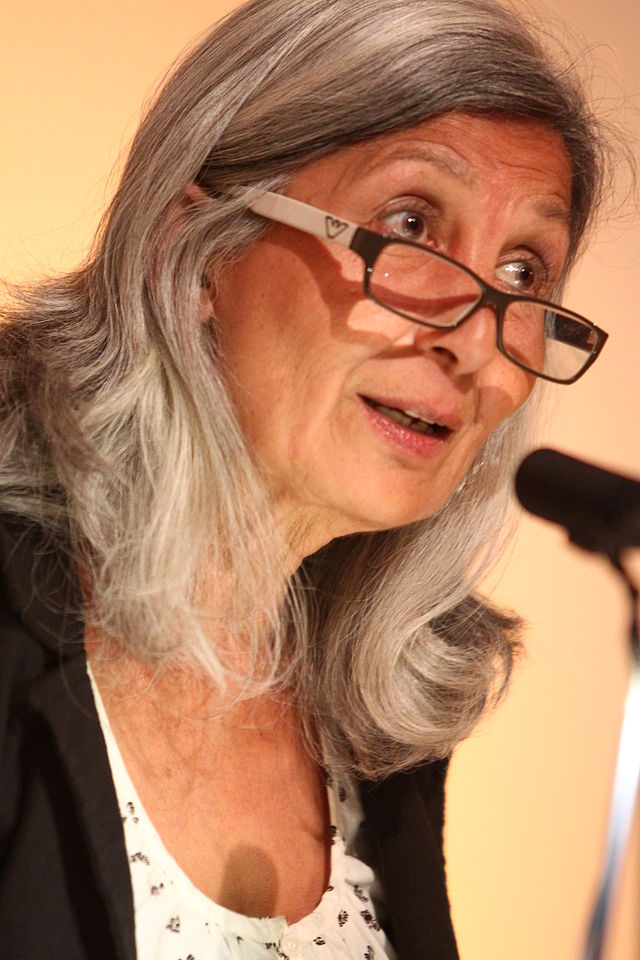
For the past 20 years of the Manchester Literature Festival, the Rylands Research Library has hosted an annual event of poetry reading, delivered each year by a guest poet. This year, the festival had the privilege to host the acclaimed, much-beloved poet, Mimi Khalvati.
The event, co-hosted by The University of Manchester’s Centre for New Writing and Carcanet Press, began with a small reception at the new, extended building of the library, where guests and festival attendees greeted each other and enjoyed refreshments. Khalvati, in a dark blue dress and silver hair, sat comfortably in the sitting area, surrounded all the time by friends, colleagues, and visitors, who had the pleasure to converse with her before the reading itself.
Ahead of the designated time, we were invited to move upstairs, into the historic library. Up the stairs, one could notice the collision of old and new, as the white walls of the extension building hung slightly into red-bricked walls. The crowd paced slowly into the main reading room of the Victorian library, which celebrated its 125th birthday this year, and took their seats under the stone arches, surrounded by wood and ancient books.
Mimi Khalvati is a British poet of Iranian descent. She is a recipient of the King’s Gold Medal for poetry and the Jhalak Poetry Prize 2025. At the age of 81, she has published hundreds of poems throughout her career, which were all recently collected in one volume - “Mimi Khalvati: Collected Poems” (Carcanet Press). She is a co-founder of the Poetry School and teaches at the Arvon Foundation. A Carcanet poet for thirty-five years, Khalvati worked closely with Michael Schmidt of Carcanet Press, who honoured her at the event and gave the introduction to her work. Schmidt read from their letters, in which Khalvati reflected upon her own work. The letter had served as an accurate first impression of Khalvati and her charm.
When Khalvati took the stage, her small figure filled up the space. With a background in theatre, Khalvati has a dramatic presence and captivating voice. She mesmerized the audience and navigated gracefully between personal anecdotes and her poetry.
At the age of six, Khalvati was put on a plane that took her to an English boarding school in the Isle of Wight. Detached from her family and culture, Khalvati’s Farsi had disappeared, replaced by English, and when her mother tongue vanished, so did her early childhood memories from Iran. She cheerfully declared she has a “habit of bad memory”, a result of living without having anyone by her side to remember with her. The sense of rootlessness and lack of family history shadows Khalvati’s poems.
Many first readers of her work mistakenly identified her poems as “Persian”, reflecting prior knowledge about the poet (and surname) to the poems themselves. However, Khalvati argues repeatedly that she had to re-learn her Persian culture, and has little sentiment for that culture. Khalvati waved herself off her family members and history and joked she “gets confused with all of those relatives”. Yet, with many poems to choose from, she read poems about both of her parents and talked at length about her grandmother, who had been her “only” muse.
With her rich voice and witty performance, Khalvati read nine poems in a chronological order, from oldest to newest. Laughing, she hoped we wouldn't notice her poems had worsened through the years. Khalvati reads her work with a sense of humor, alternating from a mysterious tone to lightness to wonder.
Constantly self-reflecting upon her work, Khalvati called herself an eternal apprentice of poetry. Throughout her rich career, she kept challenging herself to grow and experiment as a writer. For her, each book she ever wrote was an exercise, in which she set herself an assignment - tackle free verse, think in meter, understand the concept of lightness, etc. Each “exercise” was born out of her own self-criticism about her previous work, in an ongoing journey of growth.
One of such exercises is in the form of a booklet called 'Entries on Light'. One long poem, constructed from short sequences, all exploring how to be lighter. Khalvati shared that she does not write many sequence poems, especially since she isn’t a narrative writer. She writes “little moments of being”, and occasionally they connect to each other and become one.
During her readings, the audience kept quiet, hanging onto each captivating word. In between each poem, as Khalvati reflected upon herself, laughter and joy spread across the historic chamber.
Finishing off with the poem about her mother “Ghazal: In Silence”, written in the Persian form of the ghazal, Khalvati’s mesmerising performance encapsulated notions of longings and the heartache of farewell, but also made me wonder who is the voice of the poem, as its two voices seemed to alternate places with each other and left us wondering, who is leaving who?
As the reading portion of the night concluded, John McAuliffe, Professor of Poetry at the Center for New Writing, joined Khalvati for a short Q&A session. Acknowledging the size of her “Collected Poems” (“one big golden brick of a book”), McAuliffe opened with a questionnaire about the assembly of the collection, and whether the editorial process was accompanied by a sense of wonder. To that, Khalvati answered with a smile. “When you're old like me,” she said, “and you look back upon your life, it seems like they happened to someone else.” Her poetry, she explained, felt the same. On one hand, a sense of embarrassment for rough, early work, but on the other hand, a sense of amazement. She said that for so many poems, she felt today she could never come up with material as good as she once wrote, and it seems like someone else wrote them. Putting together the collection had required self-reflection, and once all of her poems were bound together, the volume of it astonished her.
The two continued discussing Khalvati’s experiences as an educator, and its influence on her poetry. Khalvati described teaching as notorious and enriching. For her, teaching is similar to being a theatre director, working together with the students in the rehearsing studio, rather than “teaching” in a formal way. Having no academic background in literature, Khalvati taught herself about literary devices, and though she believes one shouldn't learn literature via a set of strict rules, she does see value in mastering forms of poetry. “The form”, she explained, “has a way of illuminating your own work”.
Khalvati says she is fascinated by the way children interact with the world, how to become whatever they explore, and react with surprise and amazement. Similarly, she's often surprised by her own discoveries, and in a way, keeps the appearance of the young child arriving in a new country as she was. Since her approach to poetry is not motivated by a subject matter, she's flexible and playful. “When you don’t know where you're going, you're always surprised by where you end up.”
Eustacia, an MA student at the Center for New Writing, shared her impression from the Rylands Poetry Reading evening. Having no previous encounter with Khalvati's work beforehand, her strong performative reading had encouraged Eustacia to look for her work. For her, Khalvati's juxtaposition between language and memory had been significant, and as a student writing in a language other than her mother's tongue, Khalvati had inspired her to explore these themes further.
The strength of poetry readings lies within these encounters, of the unfamiliar and curiosity. I encourage any young student to attend, with an open mind and open heart, one of Manchester’s poetry reading events, and perhaps fall in love with lyric poetry all over again.
Comments
Powered by DisqusComments are provided by Disqus.