Words by Adam Harvey
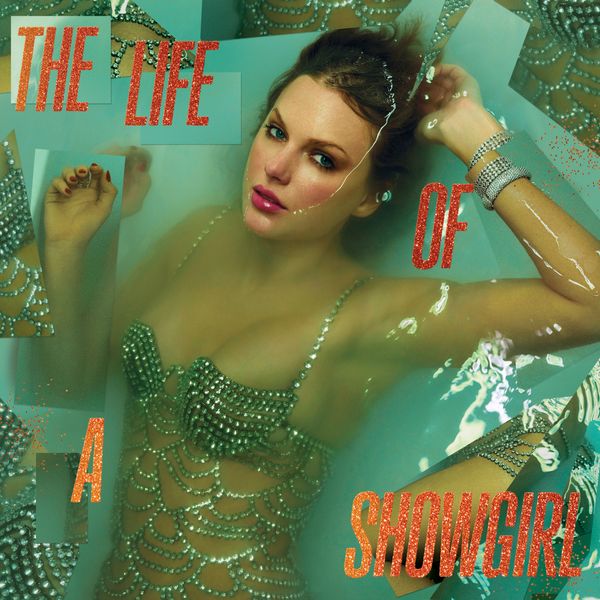
In early October, Taylor Swift released her twelfth studio album in the form of The Life of a Showgirl, a record which offers an endearing peek behind the curtain but fails to maintain a consistent sparkle.
Released just ten months after Swift’s cultural behemoth Eras Tour-de-force, The Life of a Showgirl was advertised on her now-fiancé Travis Kelce’s New Heights podcast as a showstopper full of “wall-to-wall bangers”. Co-produced by pop music legends Max Martin and Shellback alongside Swift herself, expectations were high, which the album doesn't fully fulfil. Swift’s often misunderstood lyrical genius and emotional depth have been swapped for an album of varying results that leave you wondering what on earth Swift, Martin, and Shellback were focusing on all that time.
The album starts on fine form. Lead single 'The Fate of Ophelia' is a catchy musing on Swift’s worries about her romantic fate being doomed, only for someone to step in at the last minute and “save” her. Her ad-libs blend perfectly with an electro-pop instrumental formed of a highly addictive bassline, making for an earworm that feels both interesting yet also what you’d expect from a Martin-Swift collaboration. Max Martin’s blueprint is so clearly all over this, but it works so well with Swift's writing, and her own influence remains evident in the production, even in the song structure.
This continues on album highlight 'Elizabeth Taylor'. Live strings contrast well with the pulsating beat drop of the song’s chorus, while lines such as “you’re only as hot as your last hit, baby” and “they say I’m bad news, I just say thanks” showcase Taylor Swift’s trademark playfulness perfectly. So far, so Swift, and so good. There’s promise: it’s diving into new territory in terms of sound for Swift and makes for an interesting result.
The same can’t be fully said for 'Opalite'. Whilst opening lines “I had a bad habit for missing lovers past, my brother used to call it eating out the trash” is so Swiftian, the rest of the song sounds a little phoned-in. It ends up feeling like a pleasant-enough but dull song that would make acceptable background music, especially as the production feels like Max Martin typed the term 'Post Malone-style adult contemporary pop instrumental' into an AI engine, and called it a day.
'Opalite' ends up becoming one of the songs on the album that sounds as if Swift wrote them after performing a three-and-a-half-hour show, when really she should have just gone to bed and come back in the morning with a fresh set of eyes. The line “life is a song, it ends when it ends” is mind-boggling purely because it means nothing and sounds like a placeholder line. It’s slightly infuriating, because you know all three people behind this album are immensely talented and capable of much more.
'Father Figure' offers temporary relief, with a phenomenal key change, a well-utilised interpolation of George Michael’s song of the same name, and a stomping beat that helps Swift convey the power she holds over those who tried to exploit her, but failed because her “dick’s bigger”. It’s a perfect example of how Swift can write playful lines that take you off guard - whilst they may be written off as millennial or cringeworthy, they work perfectly in the context of the song.
The same can’t be said for 'Eldest Daughter'. Track five on any Swift album have a tradition of being the most emotionally vulnerable song. They also have a habit of being some of Swift’s best songs of her career, including 'All Too Well', 'my tears richochet', 'tolerate it', and 'You’re On Your Own, Kid'. 'Eldest Daughter' does not follow this pattern. Whilst an endearing ballad about being a precocious child, it also contains lines like "everybody’s so punk on the internet” and “I have been afflicted by a terminal uniqueness, I’ve been dying just to seem cool” that let the song down.
Whilst Swift’s honesty is refreshing and her endearing nature is exactly the thing that sets her aside from her contemporaries, it also borders on being too far into cringe-inducing to be taken seriously.
If The Life of a Showgirl's predecessor The Tortured Poets Department was two hours of entrenched yearning and desperation, Swift this time looks back with a newfound nostalgia and softness.
This is shown through her attempt to revive her trademark storytelling on 'Ruin The Friendship', but this only slows the album’s tempo. The inclusion of this track is confusing in the bigger picture of the rest of the album, taking away most of the emotional impact it may have had and leading it to be simply inoffensive: not really what was intended about a song that tackles regret, death, and grief. The song also needs refining, because the lyrics as they are feel clumsy, and you can’t help but wonder if “I should have kissed him!” is really the sort of takeaway one should have after their friend dies.
The inevitably controversial, grungy Weezer-esque diss track, 'Actually Romantic', is actually an album highlight, a victory lap. It’s not exactly as mean-spirited as every think-piece on the internet is making it out to be, but rather more of a witty retort on a fellow artist who has an extensive history of making indirect snide remarks publicly aimed at other female artists online (FKA twigs, Camila Cabello, MARINA, Rina Sawayama).
The track sees Swift make it clear that she does not care what this artist has to say about her. The line “how many times has your boyfriend say, why are we always talking about her?" should have been enough to end the entire discourse with Swift firmly in pole position, but the internet seems to have decided otherwise.
'Wi$h Li$t', however, is not as remarkable. Whilst it does have a great bassline and an impressive bridge, it is a track that covers Swift’s romantic ideals in a way that seems rather dull and amateur compared to her other songs on the same subject from past albums.
The following track 'Wood' is also a romantic ode to Kelce, but is enjoyable because it is a fun, funky pop song that doesn’t take itself too seriously: Swift knows what she’s doing with the double-entendres about “knocking on wood”, and she seems to absolutely love it whilst doing so. The song proves that not everything has to serve as an example of her penmanship at its best, and the album is at its most fun when Swift drops that pretence, even if it’s not even her strongest song about desire or sex.
'CANCELLED!' is the album’s biggest misstep. It lacks the bite of Swift’s previous wrathful anthems about fame: the best lyrics about negative perception have already been said in 'Elizabeth Taylor'. One does wonder what on earth a song about staying friends with Blake Lively has to do with being a showgirl, or if Swift ran out of ideas and needed to pad out the track list in some other way. It has all the clichés of a musical theatre track, and is far more embarrassing than it is cunning.
'Honey' is a radical improvement, and has much sharper barbs about what people have to say about her whilst being less vengeful; the track is still sentimental and vulnerable, encapsulating the peek behind the showgirl curtain that Swift offered the album as.
The Life of a Showgirl’s title track is a show-stopper of an album finale, and Sabrina Carpenter’s appearance is very clever given the compatibility of the two’s personas: she fits the song perfectly, especially in the light of her appearance as one of many support acts on Swift's Eras Tour. It pulls off the cabaret influences that previously failed in 'CANCELLED!'. The song’s outro is a brilliant act of fan service, acting as an ode to the Eras Tour itself and a reminder of Swift’s legacy, even after an album of mixed results.
Whilst it is clear to see what Swift was trying to do and where she was coming from on this album, there is no ignoring that the execution is poor, the lyrics need refining, and the production often sounds as if Max Martin and Shellback spent most of their studio time scrolling on their phones.
The sequencing is odd, resulting in songs that feel cohesively incongruent next to one another. There is also a lack of innovation on most of the tracks of this album that leads to the dulling of its promised razzle-dazzle, with Swift's trademark self-referential nods (that are usually laced with humour) now feeling more like a re-treading of the same tropes, with little new to say.
That being said, The Life of a Showgirl does show promise, and offers great pop songs when it wants to. This is Taylor Swift’s circus, and these are her monkeys, and they perform absolutely fabulously when Swift has a proper handle on them. It’s just a shame that they do not stay behaved throughout the entirety of the album’s runtime.
Comments
Powered by DisqusComments are provided by Disqus.