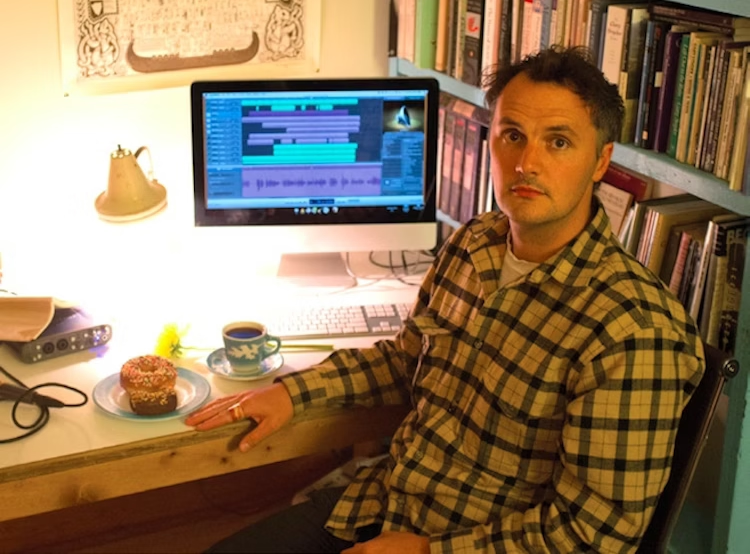
Phil Elverum has had a career that now spans around 30 years, releasing primarily under the names The Microphones and Mount Eerie; in this time, the artist has developed an expansive discography. Tackling his albums one by one would be a disservice: each feeds into a greater whole, a personal mythology. Elverum will pull out lines and themes from one album and develop upon or challenge them on another, in the process conveying his philosophy on the world and how his life has changed it.
A Crow Looked at Me (2017)
Most notably, Elverum’s wife, Geneviève, died in 2016, a tragedy that made the breakups or minor crises that had been the focus of his career pale in significance. 2017’s A Crow Looked at Me is unflinchingly honest and entirely tragic as a result. It documents Elverum's absolute grief, free from abstraction or any attempt to find any solace. On the opening song, ‘Real Death’, he says “when real death enters the house, all poetry is dumb”, a complete rejection of the very thing he had built his career around. Elverum's iconoclasm is not limited to this: on the songs ‘Emptiness Pt.2’ and ‘Soria Moria’, the artist confronts his previous desire for solitude now that it has been enforced upon him, stating “conceptual emptiness was cool to talk about back before I knew my way around these hospitals”.
None of this is done to attack his earlier work, however. Instead, it emphasises the grief he feels. Most of the time, art about death seeks some silver lining: it talks of when we recover from our sadness, or about how the dead are in a better place, or of the great life they lived. A Crow Looked at Me rejects this, and in doing so shows that sometimes there is nothing but grief, leaving coping mechanisms futile. This gives the album a unique relatability for anyone who has lost someone close to them, even if the hurt didn't amount to Elverum's.
Now Only (2018)
A Crow Looked at Me was followed by Now Only, an album rooted just as deeply in grief, but also exploring what comes next. In contrast to the short, blunt songs on its predecessor, Now Only largely takes the form of sprawling stream-of-consciousness monologues. While these explore more than can fit into one article, there are two main strands. The first is the struggle to move on from grief. As he puts it on ‘Earth’, “I don’t want to live with this feeling any longer than I have to, but also I don’t want it to be gone”. While grief is overwhelmingly painful and renders Elverum barely functional, it is also the last thing left of his relationship and thus not something he can let go of easily. We can further see this on ‘Crow, Pt.2’, which embarks on something a lot of Elverum’s music does: go into dialogue with past songs. It is a sequel to ‘Crow’, from A Crow Looked at Me. While the original focuses very directly on loss, the sequel instead focusses on the pain of Geneviève’s memory slowly receding from his mind. To express this, he reuses a line from the 2007 song ‘Lost Wisdom’; her memory, he sings, has become “a quiet echo on loud winds”.
The second key strand through Now Only is the absurdity and painfulness of putting out into the world, and having to perform, an album that is so fundamentally vulnerable. This becomes evident early into the first song, ‘Tintin in Tibet’, through the line “I recorded all these songs about the echoes in our house now and then I walked out to play them on a stage”. The phrasing here makes everything seem so overwhelmingly personal that it verges on trivial from an outsider perspective – while the delivery is laden with grief, the words themselves could just as easily be describing a plumbing problem. He insists, instead, that “I sing to you, Geneviève”. But he also remains aware of the presence of his listeners, though in his view they cannot come close to feeling what he feels or to truly understanding why he feels it.
This can be seen even more starkly on ‘Now Only’ where Elverum references playing “death songs to a bunch of young people on drugs” at a festival. All in all, Now Only follows up A Crow Looked at Me perfectly. It explores both what comes after the pain Elverum showed on that album and how he feels about having shown so openly that pain to the world. At the core of it, though, the artist begins to come to some sort of solace. Though he fights against it, his grief is lessening and he’s aware that he needs to move on and find a way to be genuinely happy again.
A Crow Looked at Me and Now Only certainly do not invalidate any of the weight of Elverum’s earlier albums. Though he challenges some of the sentiment on them as a rhetorical tool, they still hold up as brilliant both in their own right and as part of the mythology of his music.
The Glow Pt. 2 (2001)
Though he had been making music since the mid-nineties, Elverum’s breakthrough came in 2001 with The Glow, Pt. 2. A sprawling one hour and six minutes long, the album focuses on a breakup and Elverum’s attempts to recover from it. As is evident from the title, the project is rooted in his even earlier work: it references It Was Hot, We Stayed in the Water, an album released the previous year, where the "glow" is a metaphor for love. On that preceding album, he sings about this in the context of a still-going relationship. On The Glow, Pt. 2, however, that love has ended and Elverum is left feeling impotent.
This can be seen in the album's titular track, where Elverum tries to be vulnerable and show the love he has in him to those around him, but feels that it falls on deaf ears as “no-one could see that the skin on my shoulders was golden”. Throughout the rest of the album, Elverum documents his pain much as he does on A Crow Looked at Me, without mitigation. Though more metaphorical in its delivery, this is not an album that ends up coming to any resolution: on its final track, ‘My Warm Blood’, Elverum is left isolated and dying on the ground, with all attempts at recovery having failed. Right at the end of the song, the melody from the opener, ‘I Want Wind to Blow’, is interpolated, and Elverum is right back where he started.
Dawn (2008)
Dawn, released in 2008 but written during a period of isolation in a Norwegian cabin in 2002, develops upon The Glow, Pt. 2. ‘Moon Sequel’, for example, follows on from ‘Moon’. Both songs document Elverum’s preoccupation with his ex-lover as well as the disillusionment he has been left with. Elverum describes the wonder he felt looking up at the moon with her, which now seems completely meaningless to him. The original captures everything very directly, while the latter focuses more on long term effects "now it’s me who’s gone", something representative of the tone of the album as a whole. Elverum's ex-lover is in smaller focus here, and he is instead more critical of how he dealt with the breakup.
For example, on ‘Great Ghosts’ Elverum sings about how moving to the cabin didn’t help him escape his sadness, but rather made the feeling stronger as he “didn't count the fact that I have ghosts in my mind”. While there are moments where he seems to have come to some degree of solace, Elverum seems more content to dwell in bleak hopelessness, self-loathing, and the “conceptual emptiness” that he derides on A Crow Looked at Me. As he puts it, "in revenge for my burning I burnt the whole world, and was warm for a little while".
Other projects, however, begin to offer some resolution to his sadness. 2003’s Mount Eerie uses climbing a mountain as a metaphor for overcoming loss. His sense of feeling small, something ever-present on The Glow, Pt. 2 and Dawn, is directly confronted, and by the end of the album he becomes at peace with it. Meanwhile, ‘You Swan, Go On’, from his 2008 album Lost Wisdom, puts breaking up in a positive light, expressing gratitude at having been able to have had the person in his life at all.
Microphones in 2020 (2020) and Night Palace (2024)
Meanwhile, since Now Only, the mythology of Elverum’s music has only been developed further. Elverum has released arguably his two most impressive albums – and certainly his most philosophically powerful – Microphones in 2020 and last year’s Night Palace. These two interplay with each other perfectly, both in form and content. The former is composed of a single forty-four-minute-long song while the latter features twenty-six songs spread over one hour and twenty minutes. These two diametrically opposed approaches are mirrored in the focuses of the albums.
Microphones in 2020 is essentially an autobiography, inward-looking and focussed mainly on Elverum's life up until the release of The Glow, pt. 2, while Night Palace is deliberately outward-looking. Speaking on this, the artist revealed to The Guardian that he “didn’t want ‘Phil Elverum’ to be a character on this album at all”. While he does describe his own experiences, there is very little focus on the detail of Elverum's emotions or life. Instead, the artist presents his philosophy on the world, part of which is political. He speaks on his opposition to the under-acknowledged oppression of Native Americans, most notably on ‘Non-Metaphorical Decolonisation’, a title that speaks for itself, and tackles topics such as capitalism, climate change, and Israel’s attacks on Gaza.
All of this creates an overarching and distinctly radical impression of Elverum’s worldview: the structures of western society, he argues, are fundamentally flawed, leaving humanity with a need to get more in tune with the natural world and, in some way, out of our own heads. This is presented in a less obviously political way on the closer ‘I Need New Eyes’, where Elverum reaches the conclusion that searching for meaning ultimately veers into the absurd, and it is better to accept uncertainty: “now I’m staring at a boulder trying to tell myself this didn’t arise, I need new eyes”.
Night Palace also features a focus on the nature of art. For example, on ‘Writing Poems’, Elverum thinks about the limitations of art to capture the real world when “a poem only barely says the thing halfway”. Even this links into an ultimate message that it is best to come to peace with a degree of blurriness and a limitation on how much we understand. Throughout the album, this idea drifts in and out of the songs. In this, it would be remiss not to mention Elverum’s love of Zen meditation. References to Zen texts are frequently made in the lyric annotations that accompany the vinyl copy of the album, helping Night Palace to hold up not only as a great album, but as a work of philosophy.
Within the album, Elverum maintains his mythology-building, and it frequently builds upon and interacts with his past work. ‘I Saw Another Bird’ demonstrates a degree of recovery from grief, with seeing a raven, something used as an omen of doom on A Crow Looked at Me, now rendered ordinary. Meanwhile, on ‘Demolition’, Elverum challenges the idea expressed on The Glow, pt. 2 that his “roots are strong and deep” by countering that he “dug down just barely and found cathedrals”. This is in reference to the fact that white American settlement in the part of America he’s from, Washington state, is even more recent than in most of the rest of America and is built upon the genocide of native peoples. On ‘The Gleam, Pt. 3’, meanwhile, he reuses some of the instrumental style from ‘The Gleam, Pt. 2’, a song from The Glow, Pt. 2, while challenging the sense of certainty expressed on the original.
This demonstrates a next step in a continuing process throughout his career of recontextualising his old music and how Elverum views the world around him. This is not driven by hatred of his past self but rather by natural growth as he grows older and has new lenses through which he interprets the world around him. Elverum experiences a radical shift in A Crow Looked at Me as his view on life is shaded by the death of his wife. On Night Palace, his world view shifts outward as he gains some distance from that crippling event. The Glow, Pt. 2, meanwhile, expresses the worldview he had in his early twenties.
The ability to respond to them within later works demonstrates just what a unique talent Elverum is: delving further into his music sees everything fitting together into a shared mythology and a profound impression of his changing life, but it's hardly possible to even scratch the surface of his discography.
Comments
Powered by DisqusComments are provided by Disqus.