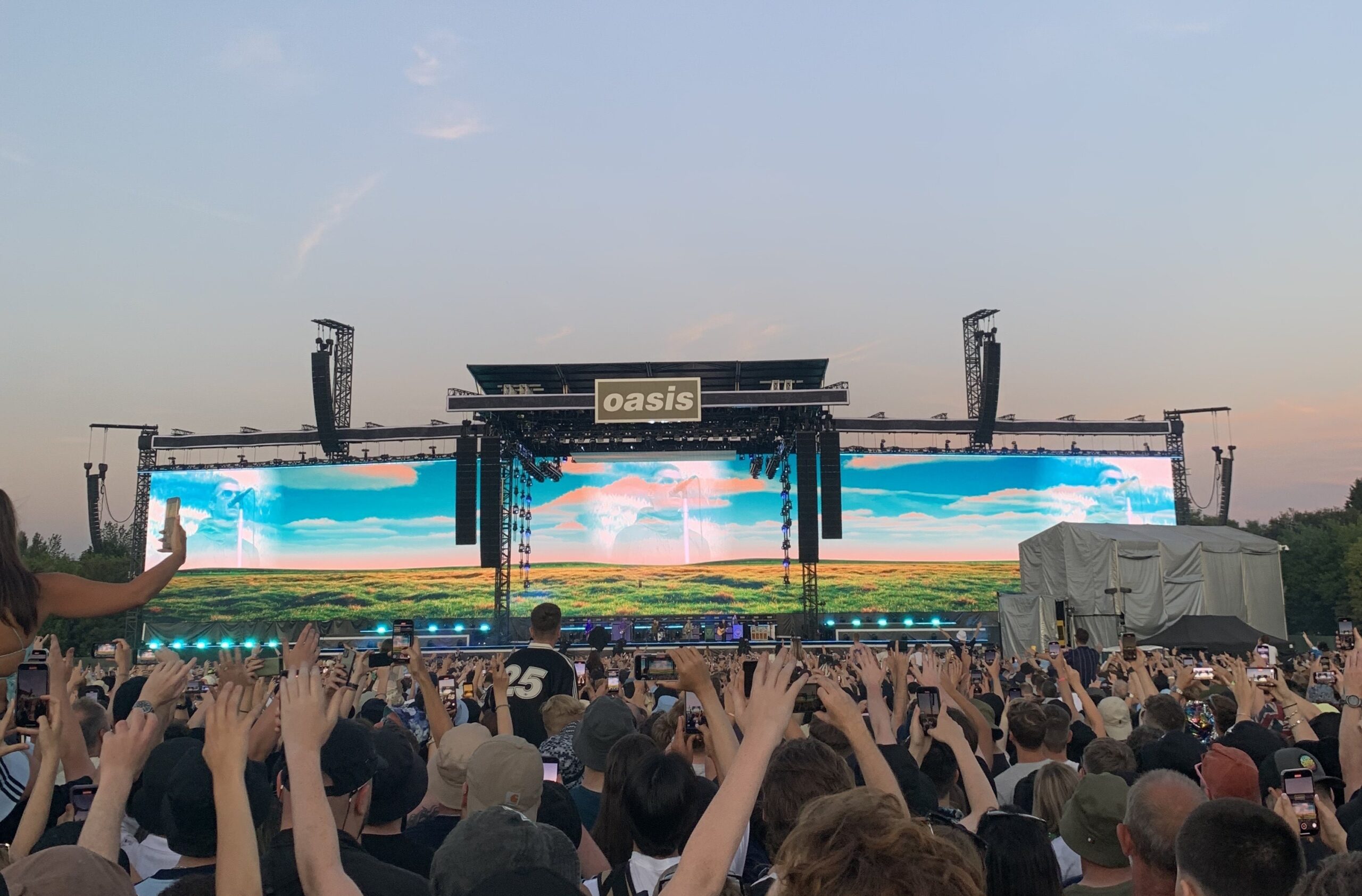
On 27 August last year, Oasis - Britpop juggernauts, cultural icons, and perhaps the group with the largest cultural footprint since The Beatles - announced their reunion. There has been little else talked about since that day, and little else needs to be said about Oasis as the indelible image of nineties hedonism - for many, the band are reminders of their personal ‘glory days’, for many others, the soundtrack to their childhood, to house parties, to field-based piss-ups.
Rumours had been circulating in press circles for some time, and there has always been a level of speculation as to how much of the Gallagher feud was genuine brotherly angst caused by the stresses of tours, frequent excess, and artistic temperaments – and how much of it was theatre. For 16 years, the brothers have fought a proxy war in the press, trading distanced blows while appearing on talk shows to promote their solo work, spinning increasingly resentful accounts of the break-up, and (I’m looking at Liam) firing particularly venomous online salvos at their erstwhile bandmate. The fabled dislike between the two brothers made their reunion seem a remote possibility, especially with the consistent, public denial of all involved that this would happen, ever. Certainly, as the possibility seemed more and more remote, the price tag for brotherly reconciliation continued to creep up.
There is an unpalatable undertone to the reunion: Money! Money! Money!
The Ticketmaster dynamic pricing fiasco, fans who paid less than a tenner a ticket in the nineties now shelling out small fortunes, just shy of 1 million tickets sold across the UK reunion tour, Noel recently finalising an expensive divorce – you do the maths. Indeed, with queues down the street for the newly opened ‘Oasis Fan Store’ in Manchester’s glamorous Spinningfields, peddling hoodies, tracksuits, bucket-hats, football shirts, and everything else that the Radio X listener in your life could possibly hope for, it is hard to escape a certain nagging feeling that we are being sold ‘Oasis’ as a corporate package, complete with limited edition merchandise and unreleased B-sides. It seems very different to the Oasis rock’n’roll of the nineties; Noel has attributed the success of their first two seminal albums to the fact that he was writing for people like him, young people with little money and few prospects, and that his words resonated with the feeling and state of a generation – 30 years on, do they still have that feeling bottled? Besides, don’t we, as young people, have a right to our own Oasis, instead of riding the coattails of our parents’ generation?
This, as a cynical young music journalist, was my state of mind the morning of the second Heaton Park gig. There are times, however, when you have to let yourself succumb to the gravity of the moment– this was one of those times.
Even on an average day it can feel like Manchester revolves around the Gallagher mythos, but the morning of Saturday the 12th of July 2025 was something else. Walking around the Arndale centre, the sun beating down on Market Street and Piccadilly Gardens, the whole city seemed to have taken the day off and be in full, unified preparations for the coming evening – a jubilee celebration for visiting Kings, for the return of two of Manchester’s wayward, prodigal sons. Every dozen or so steps would take you from the sonic field of one Oasis classic to another, the bucket-hat-per-capita ratio was higher than at any point in human history (bar Spike Island); high-vis Metrolink officers circled the city’s tram stops like a private militia – the whole city in a cloud of anticipation and excitement, as though everyone was on their way to Heaton Park.
It’s hard not to get swept up in something like that.
Pouring off shuttlebuses and trams, winding columns of fans approach Heaton Park like an invading horde, descending on one of the five entrance gates, passing hooky merch salesmen and pubs and homes blaring music in the early evening sun. 80,000 fans – and that’s not counting the thousands more who gathered just outside of the fencing to watch and listen without a ticket. It wasn’t so much the music as it was the atmosphere, it is rare to be so conscious of the fact that you are in a moment that is culturally important.
Following a definitive set from Richard Ashcroft, with the strings of ‘Bittersweet Symphony’ echoing around the park, the thunderous drums and ricocheting guitar of ‘F****n’ in the Bushes’ crashed out from the stacks of amps and speakers facing the crowd – “we put this festival on you bastards, with a lot of love!”. Immediately, half the audience were covered in airborne lager – refreshing, during a heatwave. Even if you couldn’t see the stage (which most in general standing couldn’t), the sudden presence of the band members was unmistakeable, there was a shift in the whole dynamic of the crowd; the place went wild, and it didn’t stop until they did.
Early in the set, a young lad in front of me climbed up onto a pair of shoulders and, turning around to see the seething tens of thousands behind, his eyes widened, mouth dropped open slightly, and, to sum up what he saw, h could muster only the words: "What the f*ck?". It was, in all honesty, nuts.
And no wonder, even for those in the population who don’t count themselves as Oasis diehards and had found themselves, by some miracle, in the crowd by mistake, there would have been few songs which they didn’t know at least some of the words to. It was a set of greatest hits: ‘Supersonic’, ‘Slide Away, ‘Live Forever’, ‘Talk Tonight’, ‘Don’t Look Back in Anger’ – without the listing the whole setlist, they did them all – ‘Wonderwall’ was even dusted off for the occasion. Nobody was immune to the mania, which spread round the whole park from the first minute and rose to a frenzy during the performance.
There was not a single moment in the set that could have been omitted. Every song evoked real emotion from the crowd. I said earlier that Noel credited the success of his earlier writing to the fact that he had captured the mood of a young generation, the generations have moved on, but the mood remains the same, and those songs still have it bottled. Fans from sixteen to sixty love those songs just the same, and though they may mean different things to different people, they mean just as much. These songs have become separated from Noel, from Oasis, from a particular generation of people, and they have become something else, something that represents a certain time of life, and a certain catharsis.
Liam’s voice sounded better than it has in years, better certainly than at any point with Oasis past around 2003, but the most striking thing about the performance was the two brothers’ harmonies, with Noel providing his falsetto accompaniment. On tracks like ‘Acquiesce’, ‘Slide Away’, and ‘Stand By Me’, their voices fit perfectly, Noel’s higher-range backing vocals gliding over the grittier, wider sound of Liam’s offerings. Having seen both brothers live in their solo careers, I was curious as to how different it would be to see them together; these harmonies are what make the pair something special when combined. That, and the confidence which they seem to gain from one another, slipping easily back into the rock’n’roll-er part they have been so used to (and, of course, Bonehead).
There have been few times where it has been so easy to make friends in a crowd, Oasis have been known in the past to bring a certain testosterone fuelled machismo to their live performances, but maybe everyone’s grown out of that now; when it wasn’t throwing itself around, the crowd was one big swaying mass, with arms around its shoulders. At no point was this more so than with the final song of the evening, ‘Champagne Supernova’, as pyrotechnics lit up the sky around north Manchester.
I think there are questions to be asked, about the pricing fiasco, about the insane costs of live performance in the modern industry that so limits the ability of small artists to perform, about the lack of a similar socio-musical movement for our generation that Oasis represented for theirs, about Manchester as a city holding its musical heritage in such high regard while paying little heed to its future in grassroots venues and artists – but they are questions for tomorrow morning.
As the band left the stage and the thousands of fans began to filter out back towards the city, piped home by the same spots till blasting the group’s music, one thing was clear : Oasis have captured something very special.
They are a moment in time.
Comments
Powered by DisqusComments are provided by Disqus.