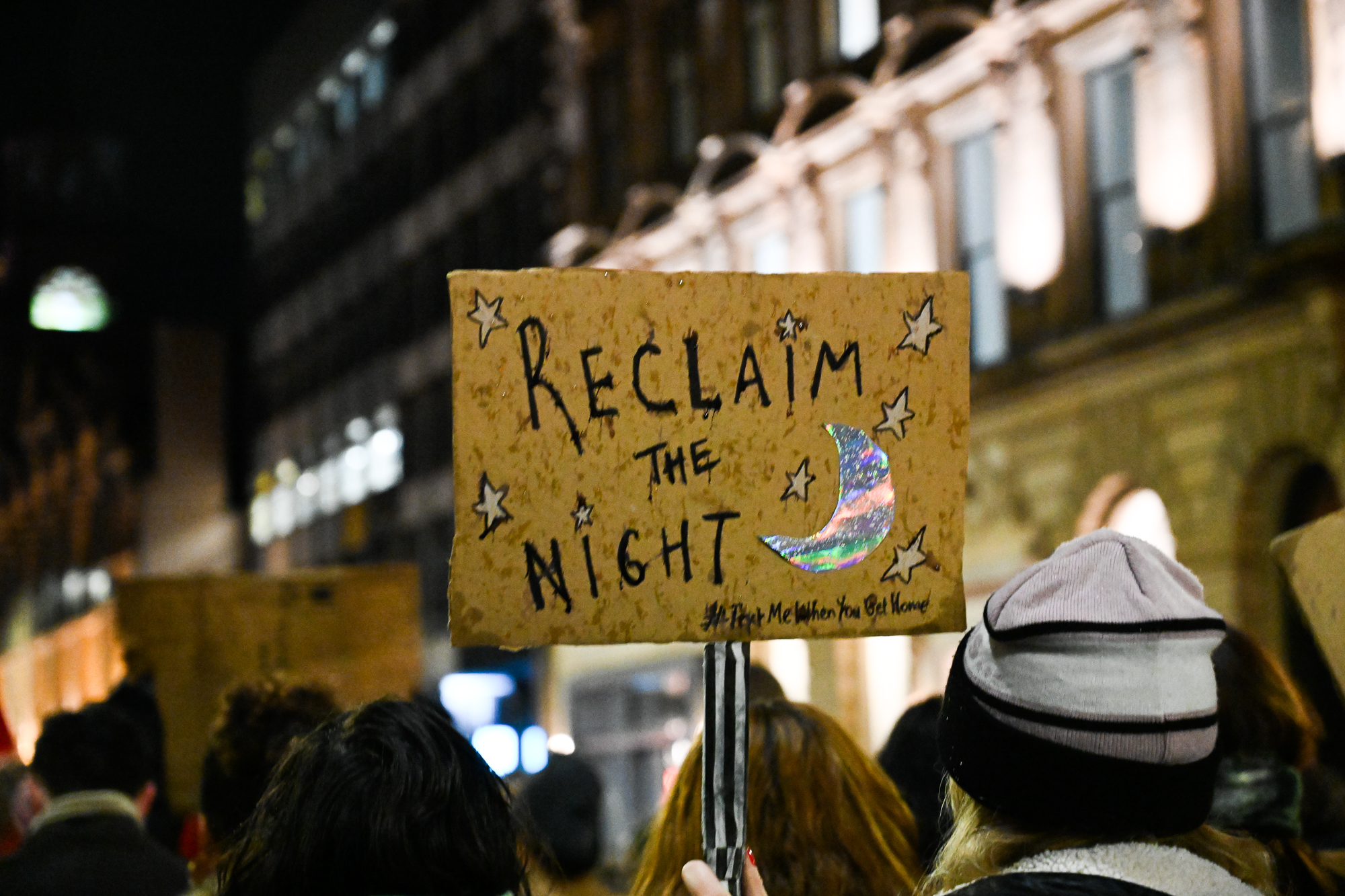
Manchester students marched up Oxford Road on Thursday 22 November as part of the annual ‘Reclaim the Night’ demonstrations.
Students gathered in protest against continued violence against women and marginalised genders, bringing light to the continued issue of night-time safety.
Last year organisers changed the route, taking demonstrators up Oxford Road and to the Great Northern in the City Centre for speeches. This year saw additional changes with the introduction of 2024-specific key aims for the movement in response to criticisms that the march was performative, in addition to calling for political change that protects women and marginalised genders.
“Make student bus routes (142 & 111) 24 hours so that everyone can get home safely”.“Ensure employers of students in the city guarantee safe transport home after a late-night shift”. This is part of the Unite the Unions ‘Get me Home Safely’ campaign.“Make the women’s nighttime safety charter inclusive of trans people”.
Additionally, there was an email blockade to the Mayor of Greater Manchester Andy Burnham. The Students’ Union website includes a ready-made email template with all the aims laid out alongside a call for local government to take action.
This collective email action was brought up at the end of the event, with a QR code attached to one of the banners. There was confusion from the crowd as it was difficult to spot and seemed non-functional (at the time).
Roman, who runs a local charity, was especially supportive of the second claim: “If people are willing to go out to work at night, they should feel safe”.
Wellbeing and Liberation Officer Aisha Akram expanded to Mancunion reporters further on aim two, describing the ‘Get Me Home Safely’ campaign’s attempts to lobby “for the council to tie liquor licences to getting their employees home safely”.
Detailing her support for the key aims, Akram went on to state “In previous years it has mainly been a march and nothing has really followed through, and I really wanted to make sure it wasn’t seen as performative and ensuring that we had concrete aims that students could march for and identify with, that's why [the aims] were created with students as well”.
The -1°C temperatures and snow flurries did not deter the sizable crowd from loudly proclaiming their support for the cause. Inna, a third-year Drama student noted that the group of demonstrators was “smaller than previous years” but also stated that “I think it’s still powerful and still important”.
As homemade cardboard signs started to disintegrate in the freezing temperatures, crowds of students gathered outside the Students’ Union building. Excitement seemed widespread through the crowds as participants engaged in chants such as “Whose streets? Our streets!” and “This is what a feminist looks like”.
Whilst passing the Alliance Manchester Business School, some demonstrators were upset by a crowd of men holding up offensive hand gestures through the Oxford Road facing windows.
Additionally, there was frustration from passers-by over buses being held up for the safety of march attendants. Some members of the public were spotted filming and photographing the evening's events.
Other than minor disruptions, members of the public were supportive. Groups of onlookers stopped to clap and cheer as demonstrators continued on their route past the Kimpton Hotel and Manchester Central Library.
Manchester Labour Students were in attendance, with large red banners to represent their organisation.
Vice Chancellor and President of the University of Manchester, Duncan Ivison also attended the march. He marched alongside students but noticeably did not engage in the chanting nor did he clap for the speeches at the end of the night.
When interviewed, students felt unsure if they knew the aims of the march but often (with a further push) could name at least two out of three.
Multiple SU student executives were in attendance, vocalising their support for student action in Manchester.
Akram was seen chanting at the front of the crowd alongside student community leaders.
Commenting on the importance of the event in an interview, Akram said being a part of the march is necessary for “ensuring that it [the movement] doesn’t just die down”. Referencing the historic origins of Reclaim (started in 1977 as a response to advice issued to women during the Yorkshire Ripper murders) “because nothing has changed since then”.
Union Affairs Officer Lexie Baynes was also in attendance. Commenting on the politicisation of this year's event, she said “I think it’s completely necessary for the campaign, I think it takes it off in a new, different direction. I think it’s something which we do lobby on anyway as an officer team and through the GMSP (Greater Manchester Student Partnership) so we may as well continue to work through Reclaim itself”.
She pointed out the intersectionality of this year's event, stating “everyone does have the right to literally just walk home by themselves at night and they shouldn’t feel like they are threatened or they shouldn’t feel like they’re targeted because of their gender”.
Baynes also credited fellow SU executive officer Akram as having “made a really good step by doing this”.
Referencing the freezing weather, City and Community Officer Elliot Briffa told Mancunion reporters that “it’s going to be a cold one” but acknowledged the student community's engagement in the event stating “We’ve still got a huge amount of students here regardless”.
Briffa has been working on plans for the ‘Reclaim the Town Hall’ event on Thursday 28 November, which focuses on more concrete plans for future political action. Briffa described the event as a “place for students to come together and collectively organise how we’re going to take the campaign further”.
At the end of the march, the crowd gathered in the Great Northern to listen to speeches from student society leaders as well as the Wellbeing and Liberation Officer. A BSL interpreter was present next to the speaker's stage and was well-lit to ensure accessibility.
Attendants were supported by stewards in hi-vis to ensure accessibility for participants. There were some concerns about the safety of the Great Northern steps, as well as accessibility for wheelchair attendants, due to the unpredictable icy weather.
This year there was a distinct lack of speeches from political figures, with previous year's speakers including Kate Green (Deputy Mayor of Manchester) and Bev Craig (Manchester City Council leader).
With the speakers standing on a platform, lit up with the colours of the campaign, onlooking students and members of the public cheered on sentiments such as the need for intersectionality and acknowledgement of the continued struggle of women in conflict zones.
Whilst some speakers started off their comments with sensitive content warnings (with a blanket content warning on the official web page), not all of them did.
Notably, speakers’ mentions of Palestine and other conflicts around the world elicited whoops, cheers and clapping from the crowd.
During her speech, Akram led a minute of silence “for anyone suffering from occupation and violence in Palestine, Lebanon, Sudan, Congo and human rights violations in Afghanistan and Iran”. The mood was a sombre, emotional switch from the excitable chanting prior but a necessary reminder of the historic precedence of the night’s events.
Throughout the march, students gave comments on their reasons for engaging in the night's demonstration. Many of them felt the introduction of political aims to this year's Reclaim the Night was a positive step forward.
Ruby, a first-year Politics and History student, was attending Reclaim the Night for the first time. On the topic of the march, she stated “I think that the system of gendering is inherently patriarchal [...] it affects both men and women in a way that’s oppressive”.
Scarlett, a third-year Sociology student told reporters “it’s great that there are actually aims this year, that are actionable [...] last year, and the year before, it’s just been a march”. After the commencement of speeches, students were led in political chants such as “My body, My choice”.
People disbanded very quickly after the speakers had finished. Some demonstrators commented on the lack of any plan for returning home after the march as walking through the City Centre after dark caused some concern.
Comments
Powered by DisqusComments are provided by Disqus.