You’ve probably never heard of the Carbuncle Cup – the rather churlish ‘award’ given irreverently to some poor architect for designing the year’s “ugliest building”. It’s a sneering and asinine way of critiquing supposedly poor architecture.
We’re all guilty of slagging unsightly and downright ugly newbuilds off, and yet we too often forget the reality – at least newly-built developments have a purpose.
Abandoned or defunct ones, however, are entirely fair game.
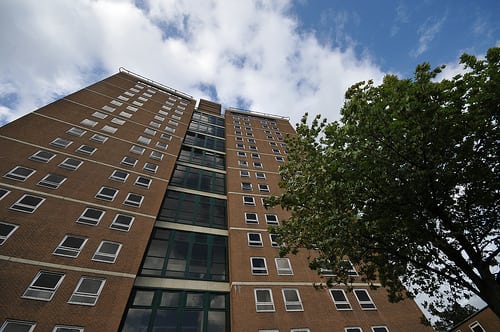
And if there’s one entirely defunct eyesore in Manchester deserving the unfortunate moniker of the city’s ugliest, it’s surely the Owens Park Tower. Now, after years of dithering, delay, and controversy, is, finally, to be torn down.
The University took the decision to close the ailing structure in 2013 after numerous problems arose, including the discovery of asbestos.
But 11 years on, the tower still stands – a sordid 19-storey effigy to a decade of inaction by a university that has kicked the skyscraper-sized can down the road and left the building and its surrounding environs to decay.
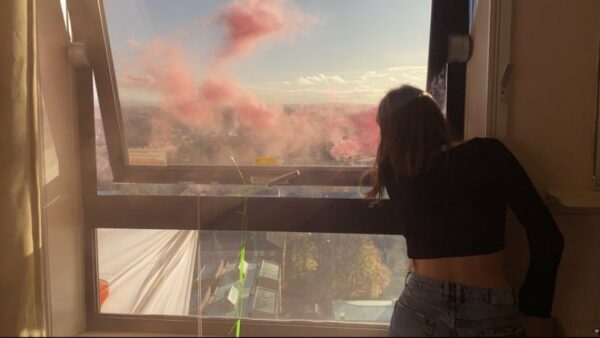
A glimpse into the view from the top floors of the Owens Park Tower, as Students set off flares from it's top floor windows during a protest. Photo: UoMRentStrike
It is right to make use of this type of land for development – no building of that footprint should stand derelict for so long. The shortage of student housing in Manchester could have been dented by swifter action to get diggers in the ground and new flats built.
Owens Park is now a shallow husk of a structure – lifeless, hollow, and crumbling. But even as it indolently sees itself into oblivion, its legend has become so outsized and iconic that even the most ardent YIMBY thinks twice before writing an article doggedly applauding its felling.
For decades it stood as the seminal landmark for UoM’s first-years – the walk home through Curry Mile down to Fallowfield is etched into every student’s brain. The sense of independence first-years get upon seeing that monolith of brick and concrete for the first time and thinking ‘ah, that’s home’ was as immovable as, seemingly, the Tower itself.
In its heyday, the Tower housed over a thousand students and was the striking centrepiece of Fallowfield’s post-war fling with brutalist architecture. The taller, rugged cousin of the nearby ‘Toast Rack’, if not as visually striking.
Owens Park is emblematic of the university experience – the infamous “Tower Challenge” ritualised the hedonistic pursuit of drinking from every floor from the built-in bar at the building’s foot to the lofty views at its summit.
The building's status as the former home of future celebrities such as Jack Whitehall, Ryk Mayall, and Benedict Cumberbatch injected stardom into the Tower’s legend and helped cement its place as the undisputed icon of Manchester studentdom. There, in that lost kingdom in the sky, had slept generations of dreamers, drinkers, and dynamos whose futures would be begun in Fallowfield’s very own Brezhnevka.

A famous former resident of the tower, comedian Jack Whitehall. Credit: Sean Reynolds @ Wikimedia Commons.
The BOP (Big Old Party), a mainstay for the more boisterous students, was held every Friday in the downstairs ballroom. The Tower, beyond the 60s-era furniture and decaying carpets, became the flagpole for the ambitious and the hedonists alike to plant their own colours and mark the very beginnings of their adult lives – “I live in Owens Park” was a statement of intent more than a simple matter of fact.
In spite of its awfulness – in some cases because of its awfulness – Owens Park became the posterchild for the campus and its culture
Thousands have come and gone from Fallowfield, but it would not be a stretch to say most would eulogise Owens Park as the very icon of UoM – the jagged, crassulent ballast of Fallowfield life.
The sentiments made clear by a Facebook page boldly entitled ‘Save our Tower’ are felt by all. Yes, it was an eyesore, but it was our eyesore.
But now, the unavoidable fact is that Owens Park, with no purpose, is just a plain old blight on an otherwise pleasant cityscape.
Prior to building work commencing, the area had become something of a dead zone on campus – a lonesome cash machine the only remnant of a once thriving piazza outside. The walkthrough to the nearest bus stop became the only reason to tread on this once lively, almost sacred soil.
The building’s fate is an unfortunate one for the campus’ culture, but out of the ashen rubble of concrete and masonry comes a swanky, if not drab masterplan for the site’s regeneration.
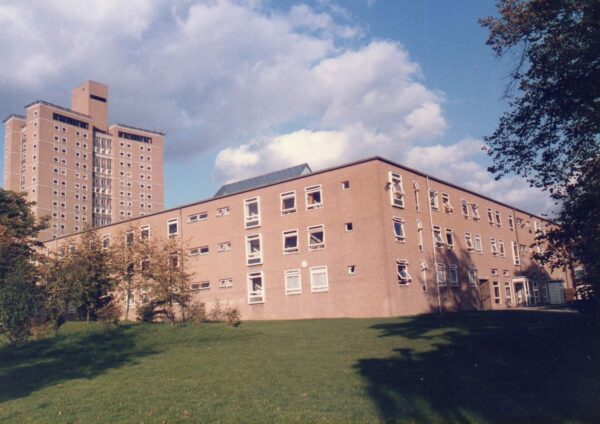
The tower, standing in all its brutalist glory back in 1985. Credit: Cjc13 @ Wikimedia Commons
UoM’s planning application to redevelop the south-west corner of Fallowfield Campus, encompassing Owens Park, Oak House, and Woolton Hall, was approved by Manchester City Council in January. The proposals will bring much-required relief to the campus’ bed shortage by adding 950 more rooms, albeit in staggeringly bland identikit buildings that will stand as facsimiles of the current Unsworth Park set.
But taste aside, this rejuvenation is needed. By not acting on Owens Park sooner, more than a decade has been lost in the fight against the city’s mounting student housing crisis. Those many hundreds of extra rooms will serve as a necessary dent in that 23,000-strong shortage. If they had been built earlier, the scandal around sending first-years to live in Liverpool and Preston could have been avoided.
Owens Park will forever be remembered by Manchester’s students. Not satisfied with leaving its mark on the skyline, the building became the iconic vision of homecoming for generations of students.
It will rightly be torn down and replaced with sleeker, more hospitable development that caters better to the fickler expectations and needs of today’s prospective students. The first-years of tomorrow will be furnished with the same amenities that we all secretly yearned for.
But one thing they will not get is the iconic view coming home after a long day down the Curry Mile – a view of home.
Comments
Powered by DisqusComments are provided by Disqus.